Monday, October 3, 2016

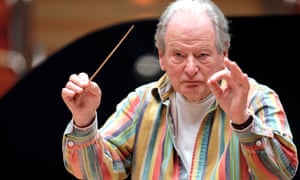
Sir Neville Marriner 1924 - 2016


Conductor Sir Neville Marriner dies aged 92.
Founder of Academy of St Martin in the Fields was still conducting into his 90s and his Amadeus soundtrack sold 6.5m copies.
Sir Neville Marriner began his career playing in a string quartet and trio, then in the London Symphony Orchestra.
Sir Neville Marriner, one of the world’s greatest conductors, has died.
The founder of the Academy of St Martin in the Fields, who conducted many of the world’s leading orchestras, died in his sleep on Sunday, aged 92, the academy said.
Marriner was still conducting into his 90s, conducting a concert to celebrate entering his 10th decade two years ago, which included a rendition of Happy Birthday. His 90th birthday was also marked by Classic FM dedicating an entire day of programming to his performances.
Neville Marriner: 'My wife has told me to keep June free'.
His soundtrack to the 1984 Oscar-winning film Amadeus is one of the most popular classical music recordings of all time. It topped the US album chart and has sold over 6.5m copies. The publicity blurb for the film said: “Only two people were qualified to conduct the score.” Below those words were two pictures: one of Mozart in powdered wig, the other of Marriner in white dickie bow. “One was unavailable,” added the blurb.
Academy chairman, Paul Aylieff, said: “We are greatly saddened by today’s news. Sir Neville’s artistic and recording legacy, not only with the academy but with orchestras and audiences worldwide is immense. He will be greatly missed by all who knew and worked with him, and the academy will ensure it continues to be an excellent and fitting testament to Sir Neville.”
Born in Lincoln, Marriner began as a violinist. He studied at the Royal College of Music with WH Reed, biographer and friend of Elgar, and the Paris Conservatoire. He began his career playing in a string quartet and trio, then in the London Symphony Orchestra. He formed the Academy with the aim of forming a top-class chamber ensemble from London’s finest players. Ironically, it was conceived as a conductor-free refuge for string-players but Marriner became, as he put it, “a turncoat” – a conductor who on stage, as often as not, held a violin in one hand and a baton in the other.
Marriner began his conducting career in 1969, after studying in the US, where he founded the Los Angeles Chamber Orchestra, while at the same time developing and extending the size and repertoire of the academy.
In 1979 he became music director and principal conductor of both the Minneapolis Symphony Orchestra and the Südwest Deutsche Radio Orchestra in Stuttgart, positions he held until the late 1980s.
He subsequently continued to work with orchestras around the globe. Marriner was music director of the academy from its formation in 1958 to 2011 when he became life president.
From its humble beginnings in Marriner’s front room as a group of friends getting together to rehearse, the academy, which gave its first performance in its namesake church in 1959, now enjoys one of the largest discographies – over 500 albums – of any chamber orchestra worldwide, and its partnership with its founder is the most recorded of any orchestra and conductor.

Thursday, January 7, 2016

1 Sem 2016 - Part One

Lang Lang
In Paris - 2 Cd's


By James Manheim
For all the crossover theatrics he has offered as he approaches the end of the second decade of his career, the Chinese phenomenon Lang Lang would not have continued to flourish without solid and even innovative performances of core classical repertory. Following up on his highly successful Chopin Album, Lang Lang scores again with this recording, put together over several nights at the Bastille Opera in Paris. The first part consists of the four Chopin Scherzos, and these play unmistakably to Lang Lang's athletic strengths. Consider the octave triplet passages that make up the main thematic material of the Scherzo No. 3 in C sharp minor, Op. 39. In Lang Lang's hands, these are not just muscular, but a breathtaking single gesture. There aren't many pianists who could carry that off, and better still, Lang Lang molds the gesture into different shapes as the piece proceeds. He has the musicality to carry off risky contrasts between loud and quiet, and in the bravura passages of these most virtuosic Chopin pieces he is simply gripping. Tchaikovsky's The Seasons, Op. 37, are less commonly played than the Chopin, and there are recordings less brittle and more oriented toward the work's French roots than Lang Lang's. But here again there is a remarkable combination of power and suppleness, and it would be hard to conceive of anyone being bored by his performances. Sony's engineering tends to favor the high end, which is already implicit in Lang Lang's playing and did not need any help, but this does not distort his work in this case. Highly recommended for those who loved the Chopin Album, and evidence of continuing worthwhile work from one of the world's most popular classical artists.
Tracks Listings:
Disc: 1
1. Scherzo No. 1 in B Minor, Op. 20
2. Scherzo No. 2 in B-Flat Minor, Op. 31
3. Scherzo No.3 in C-Sharp Minor, Op. 39
4. Scherzo No. 4 in E Major, Op. 54
Disc: 2
1. The Seasons, Op. 37a; I. January: At the Fireside
2. The Seasons, Op. 37a; II. February: Carnival
3. The Seasons, Op. 37a; III. March: Song of the Lark
4. The Seasons, Op. 37a; IV. April: Snowdrop
5. The Seasons, Op. 37a; V. May: Starlit Nights
6. The Seasons, Op. 37a; VI. June: Barcarolle
7. The Seasons, Op. 37a; VII. July: Song of the Reaper
8. The Seasons, Op. 37a; VIII. August: Harvest
9. The Seasons, Op. 37a; IX. September: The Hunt
10. The Seasons, Op. 37a; X. October: Autumn Song
11. The Seasons, Op. 37a; XI. November: Troika
12. The Seasons, Op. 37a; XII. December: Christmas


Sol Gabetta & Bertrand Chamayou
The Chopin Album


By ClassicFM
Here is an unusual selection of pieces by Chopin, more often known solely for his piano works, as well as compositions by his close friend, the composer and cellist Auguste-Joseph Franchomme.
Argentinian cellist Sol Gabetta and the superb young pianist, Bertrand Chamayou, came up with the concept of this album together and are now touring the repertoire in Europe.
The centrepiece of the album is Chopin's 30-minute long Sonata for cello and piano in G minor – one of the rare pieces Chopin wrote for a solo instrument other than his beloved piano. It makes for striking listening. Also here is the Grand Duo concertant in E major, written jointly by Chopin and Franchomme in 1832. Gabetta and Chamayou have additionally selected one of Franchomme's Nocturnes for Cello and Piano especially for this album.
The repertoire here is little-known and somewhat unfamiliar but Gabetta performs with her trademark grace and intimacy to bring a special, heartfelt romanticism to these works, which are well worth discovering.
Tracks:
Sonata for Cello and Piano
Introduction and Polonaise brillant
Grand Duo Concertante on Themes from Meyerbeer's '
(27) Etudes, C sharp minor, Op. 25/7
Nocturnes, No. 4 in F, Op. 15/1
Nocturne

Tuesday, January 5, 2016

Pierre Boulez 1925 - 2016


By Mark Brown/The Guardian-Arts
The composer, conductor, writer and performer, who directed the New York Philharmonic, had been ill for some time.
Pierre Boulez was described as an ‘exemplary man of the future’ by his friend and fellow conductor Daniel Barenboim. 
Pierre Boulez, one of the most influential and significant composers and conductors of the 20th century, has died aged 90.
Boulez died on Tuesday at his adopted home in Baden Baden, Germany. A family statement read: “For all those who knew him and who could appreciate his creative energy, artistic standards, availability and generosity, his presence will remain vivid and intense.”
Boulez had been ill for some time and had been unable to take part in the many celebrations held across the world for his most recent birthday.
As well as composing, Boulez was a prolific writer and pianist and an inspiration for generations of young musicians.
Paying tribute, fellow conductor and musician Daniel Barenboim said: 
"Today, the music world has lost one of its most significant composers and conductors. Personally, I have a lost a great colleague, a deeply admired creative mind and a close friend."
"Pierre Boulez and I first met in Berlin in 1964 and there have been few fellow musicians with whom I have developed such a close and important relationship in the 52 years that followed – even though we always stuck to the formal ‘vous’ when speaking to each other, a rarity in our rather informal world, but from my side, certainly, an expression of my deepest respect and admiration."
“‘Creation exists only in the unforeseen made necessary’, Pierre Boulez once wrote. With this belief as his paradigm, Pierre Boulez has radically changed music itself as well as its reception in society. He always knew exactly when he had to be radical because it was a necessary requirement for music and society to develop. He was never dogmatic, however, but always retained his ability to develop himself further. His development was based on a deep knowledge of and respect for the past. A true man of the future must know the past, and for me, Pierre Boulez will always remain an exemplary man of the future.
“Pierre Boulez has achieved an ideal paradox: he felt with his head and thought with his heart. We are privileged to experience this through his music. For this, and so much more, I will always be grateful.”
The French president, François Hollande, said: “Pierre Boulez made French music shine throughout the world. As a composer and conductor, he always wanted to reflect on the ages.”
As a conductor, never with a baton, Boulez appeared with some of the world’s greatest orchestras, including the Concertgebouw in Amsterdam, the Berlin Philharmonic and the Cleveland Orchestra. He led the BBC Symphony Orchestra from 1971 to 1975 and was simultaneously music director of the New York Philharmonic from 1971 to 1977, succeeding Leonard Bernstein.
Also in the 1970s, the then French president Georges Pompidou invited him to found a new contemporary music centre called the Institute for the Research and Coordination of Acoustics and Music, known as Ircam.
Boulez was a maverick and provocateur, once declaring that that any composer who did not acknowledge the necessity of Schoenberg’s 12-tone system was “useless”. Another of his quotes was: “Operatic tourists make me want to vomit.”
He also dismissed Dmitri Shostakovich as a composer who “plays with cliches most of the time”, and said classical music’s history “seems more than ever to me a great burden. In my opinion we must get rid of it once and for all”.
Boulez was a long way from being stuffy and in 1973 took the chairs away from orchestra members of the New York Philharmonic, replacing them with rugs and cushions so they were more in line with the city’s coffeehouse culture and hippie scene.
George Benjamin on Pierre Boulez: 'He was simply a poet'
In the 1980s, he worked with Frank Zappa, resulting in the album Boulez Conducts Zappa.
One of a generation of pioneering post-second world war composers, Boulez helped steer contemporary music in radical new directions. He pioneered serialism in music, embarked on open-ended and improvisatory music, and experimented with what he called “controlled chance”, in which performers were offered choices about what to perform in music Boulez had written.
Boulez was born in 1925 in the town of Montbrison, near Lyon, and grew up in Nazi-occupied France. He was 20 when the second world war ended, which could offer one explanation for his energy and zeal to make a difference – or as he once said to his teacher Messiaen – “to put music right? It’s in such a terrible state”.
His friend and fellow composer George Benjamin praised Boulez in an article for the Guardian last year. “Through the power of his personality, the scale of his reputation and his considerable personal charm, Boulez has made big things happen, way beyond the confines of manuscript paper,” he wrote.
Boulez even ended up lending his name to Private Eye’s Music and Musicians column, rounding up gossip from the classical world – the column was always bylined “Lunchtime O’Boulez”, to differentiate it from the other regular byline, “Lunchtime O’Booze”.

Saturday, December 26, 2015

2 sem 2015 - Part Four

Jan Garbarek & The Hilliard Ensemble
Officium Novum


By Stephen Eddins
More than 15 years separate the release of Jan Garbarek's best-selling album Officium from his Officium Novum. The newer release, like the original, features Garbarek on soprano and tenor saxophones and the male vocal quartet, the Hilliard Ensemble. In both albums, Garbarek takes preexisting vocal pieces and embroiders them with his soulful obbligato contributions. The chaste austerity of the men's voices and the reedy plaintiveness of the saxophone make for a surprisingly effective pairing. Garbarek and the singers manage to merge two very different musical worlds without compromising the integrity of either, and that is part of what gives these albums such an impact. The first album used primarily Medieval and Renaissance material -- chants, motets, and liturgical song -- while this second mostly uses more recent source material, primarily from Eastern Europe. In addition to several medieval sources, included are works by early 20th century Armenian priest, musicologist, and composer Komitas; Nikolai N. Kedrov, a Russian composer of the same era; mid-20th century Greek composer Giorgios Sefaris; Estonian Arvo Pärt; and several original pieces by Garbarek himself. Like the first album, this one is suffused with a sense of distant mystery and a profound, powerful melancholy that is given voice with intense feeling. The sound again is spacious and warmly resonant, with an earthy, enveloping ambience. This album will be a must-have for anyone who loved the first one, and it should appeal to any listener with an affinity for meditative Eastern European spirituality, especially when tied to contemporary expressivity and stylistic freedom.
Tracks:
1. Ov zamranali (Armenian traditional/ Komitas, Hilliard Ensemble/Jan Garbarek)
2. Svjete tihij (Byantine chant, Hilliard Ensemble/Jan Garbarek)
3. Allting finns (Jan Garbarek)
4. Litany (Hilliard Ensemble/Jan Garbarek)
5. Surp (Armenian traditional / Komitas, Hilliard Ensemble/Jan Garbarek)
6. Most Holy Mother Of God (Arvo Part)
7. Tres morillas m'enamoran (Spanish anonymous/Hilliard Ensemble/Jan Garbarek)
8. Sirt im sasani (Komitas, Hilliard Ensemble/Jan Garbarek)
9. Hays hark (Armenian traditional/ Komitas, Hilliard Ensemble/Jan Garbarek)
10. Alleluia, Nativitas (Perotin. Hilliard Ensemble / Jan Garbarek)
11. We are the stars (Jan Garbarek)


Vladimir Horowitz
Complete Recordings on Deutsche Grammophon - 6 CD's


By Doug - Haydn Fan VINE VOICE
For reasons perhaps reflecting what may very well be a coming collapse of classical music pricing and distribution, bargains of an almost too good to be true nature continue to emerge on Amazon. This certainly is one! With the already very reasonable price slashed by half, you can now purchase all six Horowitz discs making up his recordings for DG for a little over twenty-five dollars. It's a buyer's market!
This set includes the famous Moscow Concert, a number of selections of pieces Horowtiz did very well, including Schumann, Liszt, Chopin, Scarlatti, and Scriabin, and even includes a Mozart Concerto, with large-scaled backing by Giulini. By this time in his career Horowitz plays more reflectively; the huge passionate outbursts of his salad days, with thunderous dynamics and blazing tempos are not the main attraction. One should absolutely not expect the reincarnation of, say, live concerts with Horowitz and Toscanini! Instead, perhaps channeling late Liszt, Horowitz seems at his best here when playing music requiring reflection and poetry.
Of course, this IS still Horowitz the virtouso - despite his age at the time of these recordings, around eighty - there's still plenty of pyrotechnics, though I find them more careful, and with a few bald spots showing through when he strives for more full sonorites and explosions. Opinions differ on the DG sound - Horowitz apparently never made life easy for the engineers, and there is some variance here, with some of the results not at all the equal of the best modern recordings.
If you don't yet have the Cd of the legendary return to Moscow Concert, or any of Horowitz's other late DGs, this is a great chance to hear them at an extremely modest cost.

Saturday, November 28, 2015

2 Sem 2015 - Part Three

Valentina Lisitsa
plays Philip Glass - 2 CD's


By Michael Birman

Philip Glass may be characterized as a minimalist composer but his music transcends the genre. Minimalism is a catch-all phrase but basically it means a compositional style that considers horizontal development to be more important than the vertical component of a musical piece. In other words, that the melody line is the main focus of the composer's attention and, while not entirely ignoring the vertical or polyphonic (counterpoint) elements, the composer is really more interested in the temporal or melodic aspects of music rather than the spatial interplay of several lines of notes.
This is hardly a new development in the history of music. Something similar occurred around 1750 with the death of Bach, when there was a declining interest in "archaic polyphony" by composers who wanted a simpler, more immediately appealing form of music that we now call homophony. This meant creating new textures in which multiple parts move together but with a single melody line of prime importance, and a renewed interest in chords and harmony. A new aptitude for writing melody for its own sake resulted (melody had become difficult to discern in complex polyphonic music like a Bach fugue). The Classical style music of Haydn and Mozart was born. Something similar occurred in reaction to the perceived sterility of atonal and 12-tone serial music championed by Schoenberg, Webern and others during the mid-twentieth century. Minimalism led to simplification in some of the more intellectual aspects of music and there was a new interest in harmony, melody, and instrumental textures for their own sake. Philip Glass is a master of this new style and his music reflects so much more than merely Minimalism.
The three works - The Hours, Metamorphosis and Mad Rush - recorded on these two CDs by pianist Valentina Lisitsa all reflect the composer's meditative compositional style in which blocks of melody are created, examined from every conceivable angle to the point of near exhaustion until new elements can create new blocks of melody, with the process repeating itself until it seems as if a self-replicating process has begun. Of course, that is one definition of the biological processes that we call "life" and the parallels seem appropriate.
The music of Philip Glass has an organic quality that operates like a melody engine fed by musical motifs (a usually short succession of musical notes that create a single impression; or a brief melodic or rhythmic formula out of which longer passages can be developed). This organic, living melody engine is significantly more complex and a much more creative process than the name of the genre that is used to categorize it (the "M" word again) would lead you to think. Glass is a master at creating these small elements of melodic germination that power the engine that drives his music.
Lisitsa has the pianistic mastery to convey the composer's ideas with almost effortless grace. She makes it look and sound easy but it really isn't. Glass, like Mozart, is a difficult composer to play partly because the music sounds so simple while so much goes on "under the hood". Lisitsa is a pianist with exceptional control of keyboard dynamics (watch her YouTube video in which she plays the final movement of Beethoven's "Moonlight" Sonata, for an example of her brilliant use of dynamics for expressive purposes). She uses that control to emphasize different blocks of notes as they flow by but always with great subtlety, making the music sound as if it were constantly re-inventing itself, always sounding fresh and new.
Repetition, which is the hallmark of this music, is craftily de-emphasized in Lisitsa's playing by varying its dynamics, volume, velocity and even her playing style at times. Lisitsa's sparkling playing becomes an aspect of the music's creation. Her performances in all three works have some improvisational qualities, another aspect of Minimalism reminiscent of the Classical era (Mozart and Beethoven were renowned as improvisers before they were famous for their compositions). These two CDs are a superb introduction to the piano music of Philip Glass and Valentina Lisitsa is an excellent interpreter of his music. If you're a fan of the composer you'll probably love these discs. Lisitsa is a gifted pianist who appears unafraid of being challenged by new music. She certainly rises to the occasion on these exemplary recordings. Decca's engineers have crafted superb sound: the piano is nicely centered in a well-focused soundstage, its deeply resonant tone abetted by a slight application of reverb. On good systems the piano sounds as if it is in the room with you. 
Impressive recordings in all respects.
Track Listings:
Disc: 1
1. Glassworks: Opening
2. Truman Sleeps
3. The Poet Acts
4. Morning Passages
5. How Now
6. Something She Has To Do
7. I'm Going To Make A Cake
8. Olympian: Lighting of the Torch
9. Mad Rush
Disc: 2
1. Dead Things
2. Tearing Herself Away
3. Wichita Sutra Vortex
4. Escape!
5. Choosing Life
6. The Hours
7. Metamorphosis One
8. Metamorphosis Two
9. Metamorphosis Three
10. Metamorphosis Four
11. Metamorphosis Five
12. Mishima: Closing


Valentina Lisitsa
Études - Chopin & Schumann


By Virginia music lover
Not that many pianists record all the Chopin Etudes from Op. 10 and 25. The reason? They're tough to play, tougher to play very well. The Etudes span every mood, from sadness to winter storm to warlike, and were designed to test a pianist's technique and nerve.
Valentina has a lot of serve. She recorded these under the watchful eye of her public, live streaming two days of her sessions. There's no snip and paste here -- at the sessions she played each etude in whole. A knowledgeable producer would discuss the piece with her and off she'd go again. I listened to much of it and the commenters (one of the beauties of live streaming) would consistently say, "Wow, that one's perfect." Frankly, almost every one of her takes would have been recordable. As she has shown in the past, her pieces are played as a whole, keeping a singing line. Her technique is flawless, and her playing is so clear that you can hear the most minor nuance even while there is a whirlwind of notes. She is also a very fast player, but to me she never sounds rushed. Her clarity of technique means that you don't hear a jumble of sounds. I'm open to debate as to whether anyone plays the Etudes better. But I'll be listening to these on my desert island. Remember, the entire body of these is so difficult that Rubinstein never recorded them -- and he is on record as saying some of them were beyond him. Imagine.
The Schumann Symphonic Etudes are likely less familiar to many, but they are masterful (and difficult) works. The gold standard for these works has been Sfronitsky's interpretation, thankfully on You Tube. It is said no one ever played them better, and the works were nicknamed "sofronicheskie etudy." This may rile people but I think Lisitsa's version is better. Naturally, the recording is clearer -- there's a five decade gap in technology (plus Sfronitsky plays live which is often harder to record). But after the quiet opening, check Lisitsa's Tracks 26-27 and Sfronitsky (starting at about 2:30). Lisitsa's fingerwork is more agile, and every bit as lovely. On to the finale -- Lisitsa plays over 30 seconds faster and for the opening bars of the finale it sounds too fast at first listen. But she maintains the tempo and it really makes sense as the piece builds to its climax. When I went back to the Sfronitsky it sounded a little plodding.
One may disagree with the Sfronitsky comparison I made, but (a) at the very least the modern sound is more enjoyable, and (2) she plays the hell out of the Etudes.
Track Listings:
Disc: 1
1. Chopin No.1 In C Major 12 Etudes, Op.10
2. Chopin No.2 In A Minor -Chromatique 12 Etudes, Op.10
3. Chopin No.3 In E Major -Tristesse 12 Etudes, Op.10
4. Chopin No.4 In C Sharp Minor 12 Etudes, Op.10
5. Chopin No.5 In G Flat Black Keys 12 Etudes, Op.10
6. Chopin No.6 In E Flat Minor12 Etudes, Op.10
7. Chopin No.7 In C Major 12 Etudes, Op.10
8. Chopin No.8 In F Major 12 Etudes, Op.10
9. Chopin No.9 In F Minor 12 Etudes, Op.10
10. Chopin No.10 In A Flat Major 12 Etudes, Op.10
11. Chopin No.11 In E Flat Major 12 Etudes, Op.10
12. Chopin No.12 In C Minor Revolutionary 12 Etudes, Op.10
13. Chopin No.1 In A Flat Major- Harp Study 12 Etudes, Op.25
14. Chopin No.2 In F Minor 12 Etudes, Op.25
15. Chopin No.3 In F Major 12 Etudes, Op.25
16. Chopin No.4 In A Minor 12 Etudes, Op.25
17. Chopin No.5 In E Minor 12 Etudes, Op.25
18. Chopin No.6 In G Sharp Minor 12 Etudes, Op.25
19. Chopin No.7 In C Sharp Minor 12 Etudes, Op.25
20. Chopin No.8 In D Flat Major 12 Etudes, Op.25
21. Chopin No.9 In G Flat Major - Butterfly Wings 12 Etudes, Op.25
22. Chopin No.10 In B Minor 12 Etudes, Op.25
23. Chopin No.11 In A Minor Winter Wind 12 Etudes, Op.25
24. Chopin No.12 In C Minor 12 Etudes, Op.25
25. Schumann Theme Symphonic Studies, Op.13
26. Schumann Etude I Symphonic Studies, Op.13 - With repeat
27. Schumann Variation I Symphonic Studies, Op.13 -Appendix - With repeat
28. Schumann Etude II Symphonic Studies, Op.13 -With repeat
29. Schumann Etude III Symphonic Studies, Op.13 -With repeat
30. Schumann Etude IV Symphonic Studies, Op.13
31. Schumann Etude V Symphonic Studies, Op.13 -With repeat
32. Schumann Variation II Symphonic Studies, Op.13 - Appendix
33. Schumann Variation III Symphonic Studies, Op.13 - Appendix - With repeat
34. Schumann Variation IV Symphonic Studies, Op.13 - Appendix - With repeat
35. Schumann Variation V Symphonic Studies, Op.13 -Appendix - With repeat
36. Schumann Etude VI Symphonic Studies, Op.13
37. Schumann Etude VII Symphonic Studies, Op.13
38. Schumann Etude VIII Symphonic Studies, Op.13 -With repeat
39. Schumann Etude IX Symphonic Studies, Op.13
40. Schumann Etude XSymphonic Studies, Op.13 -With repeat
41. Schumann Etude XI Symphonic Studies, Op.13
42. Schumann Etude XII (Finale) Symphonic Studies, Op.13
43. Chopin 3 Nouvelles Etudes No.1 In F Minor
44. Chopin 3 Nouvelles Etudes No.2 In A Flat
45. Chopin 3 Nouvelles Etudes No.3 In D Flat

Sunday, October 25, 2015

2 Sem 2015 - Part Two

Sol Gabetta
Prayer


By James Manheim
The fast-rising Argentine-Swiss cellist Sol Gabetta took the name of this recital from the "Prayer" movement of Ernest Bloch's From Jewish Life, which she has performed as an encore to great success and to an obvious emotional reaction from audiences. She went in search of similar music, found the path partially trodden by Pablo Casals, and put together a program that is actually quite novel -- of the music on the album, only Bloch's Schelomo (track 10) is really common -- and yet seems as though it's always been there. Tribute is paid to Casals not only in the emotive playing, but in the presence of El Cant dels Ocells (The Song of the Birds), one of several Casals compositions deserving of more frequent performance. The most unusual entry here, and perhaps the least successful one, is the selection of pieces from Shostakovich's song cycle From Jewish Folk Poetry, arranged here for cello and orchestra by Mikhail Bronner. It seems to be part of the general mood, but it's not; despite the theme, it's pure postwar Shostakovich, and Gabetta doesn't quite catch its note of tension. The much-recorded Schelomo, however, fares very well here, even with a switch in orchestra, venue, and conductor. As usual, a bracingly fresh program from this charismatic and intelligent cellist.
Tracks:
- Bloch, E
From Jewish Life
Schelomo
Nigun (Baal Shem No. 2)
Méditation hébraïque
- Casals
El Cant dels Ocells (Song of the birds), with the Amsterdam Sinfonietta
- Shostakovich
Lullaby (from From Jewish Folk Poetry, Op. 79/79a), arranged for violoncello & string orchestra by Mikhail Bronner
A Warning (from From Jewish Folk Poetry, Op. 79/79a), arranged for violoncello & string orchestra by Mikhail Bronner
The Song of Misery (from From Jewish Folk Poetry, Op. 79/79a), arranged for violoncello & string orchestra by Mikhail Bronner
The Young Girl’s Song (from From Jewish Folk Poetry, Op. 79/79a),arranged for violoncello & string orchestra by Mikhail Bronner

Performed by Sol Gabetta, cello, with the Orchestre National de Lyon, Leonard Slatkin conducting.

Leonidas Kavakos & Yuja Wang
Brahms - The Violin Sonatas


By Robert Roy
It's taken a long time for Kavakos to be snapped up by a major record company after years of making modestly promoted discs for smaller companies such as BIS. (His recording of the Sibelius concerto in it's original and revised forms is one of the best performances of this much recorded masterpiece). His outings either Decca have, so far, been outstanding with a thought provoking Beethoven sonata set and a wonderful Brahms concerto with Chailly. However, I do wonder if he has been 'marketed' into this latest venture. (I'm trying to imaging the 'suits' discussing this 'concept'. "Okay, we need a new recording of the Brahms sonatas. Lots of great names have recorded them so is there anything we can do to put our disc at the top of the heap?" "I know - let's team up our latest signing with Yuja Wang. She's making a big name for herself. Let's show that she can 'do' chamber music too". "Great idea".)
Kovakos appears to be approaching these works with almost a period instrument frame of mind. Vibrato is kept to a minimum, bowing appears to have been calculated to the millimetre, (how I wish he would just SING now and again) and there is a feeling of austerity to his playing. As for Ms. Wang, well, we know that she can play BIG when she wants to but here she seems to doing her very best to keep a lid on her temperament.
The first movement of the G Major sonata has moments of idiosyncrasy. The second subject melody seems, to me, to be starved of feeling. You can almost hear Kovakosis' fiddle and bow begging to be released from their disciplined straight jacket. The pizzicato chords are most odd where the violinist accompanies the pianist. Korvakos spreads them slowly so that the top note sounds late.
Actually, another problem has already become apparent although I accept it may bother some listeners more than others. I obviously don't know if Kovakos had a cold or not when he and Yuja Wang recorded these between Christmas and New Year 2013 but, my goodness, he sniffs! It's really distracting and, while I appreciate he has to breath, this is up there with Glen Gould's 'vocalise'!
The second movt. is much better with some gorgeous double stopped playing from Kovakos. And I've heard lots of things in the piano part I've not heard before. (Surely the reason for buying yet another recording of these immortal masterpieces!). The last movement, IMHO, lacks a little of the wistfulness and regret that this music needs.
In conclusion, perhaps I've heard too many warmly romantic performances from, amongst others, Oistrakh, Perlman, Mutter, Zukerman and Mr. Heifetz to name but five great names to fully respond to this approach but I DO know that, despite my reservations, I'll be returning to this disc again and again to investigate its unique approach.

Sunday, September 27, 2015

2 Sem 2015 - Part One

Hélène Grimaud
Brahms Concertos - 2 Cd's


By Martin Buzacott/Limelight
You’ll read reviews of this CD where itinerant and half-hearted Brahmsians will tell you that the tempi taken by conductor Andris Nelsons and soloist Helene Grimaud in this utterly remarkable, inspired and inspiring recording of the two Brahms piano concertos are too slow and leaden. You must not believe them. Just as true Brahmsians appreciate the glacial tempi of the symphonies in Celibidache’s legendary complete set, so here Nelson’s slower pace is all about unfolding the Brahms universe with its profound richness of detail and astonishing warmth of tone. There are so many recordings of Brahms First Piano Concerto, but few could be classified as Desert Island Discs and in fact many are downright disappointing. Well this performance of it recorded live in Munich changes all of that, and if by the end your legs are still able to support the weight of your body, assume that Brahms just isn’t really your thing. From that first opening orchestral chord, surely the most arresting ever captured on disc, Nelsons announces the epic scope of the enterprise ahead. Just three seconds in and your breath’s been taken away, and from there, he and remarkable Frenchwoman Grimaud are like two Alices in the Brahmsian Wonderland, each glorious new entry, whether in the piano itself, on the horn, or especially in the lower strings, unfolding at a tempo beyond human agency, like the clear dawn emerging after a storm, dazzling the senses in the process. Grimaud’s drama-charged, percussive style, eschews sentimentality but remains passionate nonetheless, filled with an emotion generated from within the music itself, the performers simply a part of a much larger whole. This is Brahms in 3D, everything standing up and being counted, almost as if it has some sort of moral presence all its own, gorgeously captured by the DG engineers in this textbook example of live recording. And then, after two movements of vastly intelligent, intense colour and drama, the finale of the First enters, now transformed into breakneck pace, but never losing its shape or focus as Grimaud, noted for her technical prowess, simply rips the thing apart. The Second Concerto doesn’t have quite the same inherent drama, but here it gets treatment as the First, with a different orchestra but the same injection of momentum with each new musical incident. Some people may mark this recording down a star because of Grimaud’s noticeably heavy breathing throughout, but many more, and definitely males, will give the allure-advantaged soloist bonus points for the very same reason. My God, what a disc.


Hélène Grimaud & Sol Gabetta
Duo


By RBSProds
An inspiring, enjoyable, powerhouse meeting between two award-winning highly-individualistic classical music superstars who consider their initial meeting as fateful, not coincidence. Hélène Grimaud (who is called "the earth" in their interview), one of the greatest interpretative classical pianists who experiences sound as colors, and star cello virtuoso Sol Gabetta ("the air"), famed for the nuanced, singing quality of her instrumental interpretations and her highly emotional playing, meld their 'earth and air' talents and personae into a marvelous musical duo. It began in 2011 in a joyful, fateful musical encounter that 'clicked' immediately. In a wide spectrum of musical tastes, they cover the duo compositions of Robert Schumann, Johannes Brahms, Claude Debussy, and Dmitri Shostakovich, and this diverse program works wonderfully and has toured to great success. All performances are excellent and the 'best of the best' begins with the 'storm to calm' of the 'Finale' of Debussy's Sonata for Violoncello and Piano in D Minor; the awesome beauty and virtuosity of the spellbinding 12 minute Shostakovich Allegro non troppo from the Sonata for Violoncello and Piano in D minor, Opus 40; the fiery third movement of Schumann's 'Drei Fantasiestücke' (Three Fantasies), Opus 73 and the overpowering beauty of the familiar 14 minute Allegro non troppo and the 6 minute Allegro-Più presto movements of Brahms Sonata for Piano and Violoncello No 1 in E minor, Opus 38. Awesome Grammy-nominated performances by two great artists who form a dynamic duo of singular musical purpose. My Highest Recommendation! Five BRILLIANT Stars! (13 tracks; Time 73 minutes, 45 seconds. Booklet notes in English, German, and French. 
- This recording won the 2013 ECHO Klassic award as the Chamber Music Recording of the Year in the 19th Century Music (Mixed Ensemble category).

Saturday, January 24, 2015

1 Sem 2015 - Part One

Joshua Bell & Academy Of St Martin In The Fields
Bach


By James Manheim
Reactions to this release may well depend on how listeners feel about violinist Joshua Bell's music-making in general. Bell is an heir to the violin idols of the early 20th century, and he grabs attention and doesn't let it go: his tone is startlingly brilliant, his execution flawless, his insights into the music generally well-worn ones. In the two Bach violin concertos that make up the bulk of this Sony release, that's what's here, and he is ideally partnered by the champions in the silvery-strings derby, the Academy of St. Martin-in-the-Fields, under his own direction. He holds the ensemble together with a naturalness that takes the whole enterprise beyond the old-fashioned. But there is a new wrinkle to this release: a pair of arrangements of arrangements. Most daring, and perhaps less successful, is an orchestration of Mendelssohn's version of the Chaconne from the Partita No. 2 for solo violin in D minor, BWV 1004. Bell's idea seems to be that this is something his forerunners of a century ago might have done, and indeed the Mendelssohn arrangement is a work that gives insights into how he and his time experienced Bach. Adding the orchestra to it introduces another level of noise, however, and it's not at all clear that the result is to the good. The situation is similar with the little Gavotte and Rondeau twice filtered through Schumann and the same arranger as with the Mendelssohn, Julian Malone. None of this is going to bother listeners coming to this album already enamored of Bell's flashing tone, however, and it must be said that on that terrain he is in unusually good form here.

By Eric C. Sedensky "late-to-jazz musician"
By now, most music fans and probably all of Joshua Bell's fans will be familiar with the story of how, on a very cold morning in January 2007, Joshua Bell disguised himself as a street musician at a metro station in Washington D.C. during rush hour and played some classical music pieces for about 45 minutes. Included therein was a piece that many consider to be the most beautiful and complicated violin piece in history: Bach's Chaconne from Partita No. 2 in D Minor. He played his heart out on this difficult piece with his multimillion Stradivarius violin, but even this proved ineffective in getting the busy people of our nation's capital to slow down long enough to listen and enjoy.
It's a compelling story and statement, but more amazing to me as a Joshua Bell fan is that despite Mr. Bell's love of Bach's music, his occasional live performances of Bach sonatas and the sensational stunt at the metro station, he has never recorded Bach in the past. (That's not counting the Bach inventions #7 and #15 he did with Bela Fleck on Perpetual Motion.) Probably, just like he spent some time looking for the perfect orchestra he could comfortably play with before recording Vivaldi: The Four Seasons, he must have decided to take his time before recording the Bach pieces. Now being the busy director and conductor of the prestigious British chamber orchestra, Academy of St. Martin in the Fields, there was probably no reason to wait any longer to record some Bach.
As a former church organist who learned Bach before just about everything else, I feel I at least have an inkling of shared feeling with Mr. Bell when he said (in Michael Lawrence's film Bach & Friends) that "Bach's music makes you feel alive and it tells you about life and about the world in a way that nothing else can. Bach manages to take you through the entire range of human emotion..." That's a mouthful, but incredibly, it was this feeling that comes through in Mr. Bell's powerful performances on this CD. And as good as Mr. Bell is with his violin, let's keep in mind two more things. One is that he is being backed by one of the great contemporary orchestras, the aforementioned Academy of St. Martin in the Fields. Their depth of emotion is startling, and the clarity and overall execution of the music to sound as the composer intended puts them on a par with any orchestra anywhere. The second thing to keep in mind is, Mr. Bell also happens to be the conductor of the orchestra, so if anybody would have been able to get the pacing, feel, and flow of the orchestra to match his own vision, it would be him. In the end, all of the tracks sound refreshingly brilliant and show off Mr. Bell's ringing and swirling violin, the orchestra's limitless breadth, and the subtleties, emotions, and triumphs of Bach's music, all in one delightful and imminently listenable package.
Speaking of which, let me just point out, too, that the CD's production is quite crisp, keeping all the movements and pieces lush but even from track to track. The sound mastering and balance is flawless as well, with soft and slow sections leading into and out of the loud and fast sections, and vice versa, in a flowing waltz of quiet and force, majesty and humility, and everything in between. And what can I say about the tough look on the cover photo, a black and white "back at `cha" shot, other than, it's about time Mr. Bell shoved aside his choir boy image and used his good looks to demand attention and focus. (Maybe now that he's spent enough time in England he's gotten a little James Bond-ian on us?) The cover shot is augmented by black and white silhouette photos throughout the booklet and back cover. The overall effect is powerful, and I feel it will go a long way toward attracting people to the musical side and helping this recording gain the respect and attention it deserves.
Joshua Bell rarely (the missus would say "never") puts out a bad recording, but when it comes time to choose a favorite, I think these Bach renditions will be at the top of a lot of fans' lists. Five stars almost seem inadequate, but that's as high as it goes, so that's what this fantastic and imaginative CD gets.


Alisa Weilerstein & Daniel Barenboim
Elgar Cello Concerto Carter 


By Blair Sanderson
Making her debut on Decca, Alisa Weilerstein presents three major works of the cello repertoire with Daniel Barenboim leading the Staatskapelle Berlin. The star vehicle, naturally, is Edward Elgar's Concerto in E minor, which Weilerstein plays with commanding presence, rich tone, and emotional depth. Most listeners will be drawn primarily to this performance because of the piece's familiarity, and Weilerstein's charisma and passionate playing make it the album's main attraction. Yet listeners should give Weilerstein and Barenboim credit for following the Elgar with an important if not instantly recognizable or approachable modernist work, Elliott Carter's powerful Cello Concerto. Weilerstein is quite bold to play this intensely dramatic and angular composition, and while it's unlikely to appeal to the majority of fans who adore the Elgar, it deserves its place on the program for its seriousness and extraordinary displays of solo and orchestral writing. To close, Weilerstein plays Max Bruch's Kol Nidrei, a Romantic work that returns the program to a mellow and melancholy mood and brings the CD to a satisfying close. Decca's reproduction is excellent, putting Weilerstein front and center with full resonance, but not leaving the vibrant accompaniment of the orchestra too far behind her.

By Andrew R. Barnard 
Decca wants to turn its debut of Alisa Weilerstein into an occasion. No one has been able to erase memories of Jacqueline du Pre in the Elgar Cello Concerto; no doubt performers feel intimidated. The dominance of du Pre is realized when Amazon's editorial review tries to hype this recording by pointing out that du Pre's husband Daniel Barenboim hasn't touched the piece much without his wife. Could it be that a bit of the du Pre magic has continued with Barenboim?
The problem, of course, is that the magic was never Barenboim's. Weilerstein is left with the same mountain to climb as the rest of du Pre's successors. For Weilerstein, the best way to compete with du Pre is to try a completely different approach. Du Pre pushed forward with searing passion, baring her soul with no attempt to mask her feelings. While Weilerstein showcases Elgarian richness and melancholy, she is considerably more reserved. On the podium, Barenboim places less stress on grandeur, aiming to emphasize the work's dark undercurrent. He makes the Staatskapelle Berlin play from the bottom up. Both conductor and soloist seem to agree that reticence has its place. While they make the concerto have darker hues, the whole event ends up sounding less personal, sometimes mannered. There's little overt excitement. This hurts the 2nd movement the most, as Barenboim unwisely chooses to smooth out the sudden surprises near the opening, erasing all hushed anticipation. The rest of the concerto fares better, thankfully, with both interpreters seeming to understand Elgar's world. (There's not much restlessness, and melancholy doesn't become impatience). While there is much to admire about this recording, I miss the final thrust of inspiration. We hear personality, to be sure, but I feel that the music is being played from a distance, with Weilerstein admiring the concerto instead of completely taking over.
The Carter Concerto is new to me. It's an aggressive work with none of the beauty of the Elgar. For all I can tell, this is a fine reading. I'm sure its fans will be pleased to see it recorded by big names on a major label. If you're willing to get into the austere work, this interpretation beckons, particularly because of the wonderful sound. Weilerstein's tone is dark and biting, as if seeking to find meaning in the midst of chaos. Barenboim's conducting is full of sarcasm, allowing the work's forward-looking scoring (there's significant percussion) to come across clearly.
Weilerstein and Barenboim take Bruch's Kol Nidrei with much darkness, giving it a lonely feel. I appreciate the commitment, even though it can sound idiosyncratic. Again, excitement isn't a big concern, but it's hard to complain in the face of such lovely playing.
For Weilerstein, then, this is a success. These are interesting readings in very good sound. Weilerstein doesn't erase memories of Du Pre, but to be fair, no one has. She does prove, along with sensitive Barenboim, that there are alternative ways to success in the Elgar.
P.S. January 2014: Having just posted a review of Weilerstein's new Dvorak release, I must say that I am now a complete believer in Weilerstein, and find my initial hesitations about this album intangible. I hope to soon get around to fully editing this review.

Saturday, December 13, 2014

2 Sem 2014 - Part Six

Emerson String Quartet
Journeys


By James Manheim
The Emerson String Quartet formed in 1976 and kept the same personnel for more than 30 years. Journeys marks its final release with original cellist David Finckel, who has departed to pursue other projects (notably duo concerts with his wife, pianist Wu Han). It thus represents a turning point of sorts, and it is good to see that the group has not been content with simply recrossing safe territory but has delivered something innovative, both within its own catalog and in the general chamber music marketplace. The Emerson Quartet's repertory has rested solidly in the Haydn/Beethoven/Brahms mainstream. The group has rarely recorded Tchaikovsky, and Schoenberg never until this release. Journeys contains both, in the form of two sextets, Tchaikovsky's Souvenir de Florence and Schoenberg's Verklärte Nacht. (The Emerson Quartet is joined by violist Paul Neubauer and cellist Colin Carr.) The two works were written within ten years of each other, but they were at opposite extremes of the music of the period in their handling of tonality, and a conventional outlook would hold that they could hardly be more different. Yet the players seem to be suggesting that composers can't fully escape the spirit of the times in which they live, and that in fact, the two works have much in common. Both were written for the combination of two violins, two violas, and two cellos. Both, as the album title suggests, depict journeys, Tchaikovsky's physical, Schoenberg's psychological. And there is a certain emotionally overheated quality that spills through the neat classic forms of the Souvenir de Florence and links it to the more radical world of Schoenberg. The performances seem to stress the connection, with an unusually nervous Tchaikovsky that stresses the dissonances and a warmly Romantic Schoenberg. You may be able to find performances that bring out the basic traits of each work more effectively, but it's safe to say that they haven't been put together in this way. A bold move from some veteran musicians.


Martha Argerich & Claudio Abbado
Orchestra Mozart


By Geoffrey Norris
Mozart: Piano Concertos in C Major K 503 & D Minor K 466, Martha Argerich (piano), Orchestra Mozart, cond Claudio Abbado, DG 479 1033

Back in the Sixties, the first recording that Claudio Abbado made for Deutsche Grammophon happened to be with Martha Argerich in Prokofiev's Third Piano Concerto and Ravel's G Major. It is somehow fitting, then, and certainly poignant, that following Abbado's death last month DG should now release this coupling of two Mozart concertos, again with Argerich as soloist. They were recorded during the Lucerne Festival of 2013.
That early Prokofiev/Ravel disc was made with the Berlin Philharmonic and is still available on DG Originals (447 4382). In more recent times, however, Abbado took particular pleasure in working with hand-picked ensembles such as the Orchestra Mozart, founded in Bologna in 2004. This proved a fascinatingly fertile collaboration, producing discs not only of Mozart but also of Bach, Beethoven and Berg and, last year, a remarkable one of Schumann overtures and the Symphony No 2 (479 1061), Abbado's first recording of a Schumann symphony.
Mozart was in Abbado's very DNA, a fact that is highlighted here in the elegance, élan and well-harnessed energy in his moulding of the orchestral parts of these two keyboard concertos. The artistic partnership with Argerich is an intimate, seasoned and spirited one: the way in which her delicate fingerwork in the slow movement of the C Major Concerto is so perfectly coordinated with the woodwind instruments is just one example of how the orchestra, soloist and conductor are in complete, responsive harmony.
But on the broader front, too, this is a performance where everything works instinctively. Argerich, as always, is a characterful, spontaneous soloist but, as is equally typical of her winning manner of playing, she is thoroughly attuned to the music's scale and stylistic niceties. With Abbado as a constant source of sensitivity as regards balance and instrumental colour, this is an interpretation that is in every sense live and, with excellent engineering of sound, has a compelling immediacy of presence.
The atmosphere of tension and apprehension that Abbado triggers at the start of the D Minor Concerto fuels a viscerally exciting, aptly disquieting performance of the first movement, its emotions in flux, Argerich complementing Abbado in tempering darkness with light. She launches the finale as a true Allegro assai, but it is fit, healthy and lithe rather than in any way breathless. These are performances in which vital sparks generate palpable electricity.

Sunday, September 28, 2014

2 Sem 2014 - Part Five

Nelson Freire
The Complete Columbia Album Collection - 7 CDs


By Presto Classic
Called “one of the most exciting new pianists of this or any other age” in Time magazine, Nelson Freire celebrates his seventieth birthday on October 18th 2014. Sony Classical marks this milestone with a special original jacket collection. It contains some of the Brazilian pianist’s earliest and most coveted recorded performances, many of which have been out of print for decades. These include four celebrated concerto collaborations with the legendary conductor Rudolf Kempe, the “Prix Edison” award winning Chopin op. 28 Préludes, and large-scale sonatas by Chopin, Liszt and Brahms. Newly remastered from the best possible sources, the discs are presented in facsimile sleeves and labels corresponding to the original LP releases. 3 LPs appear here for the first time on CD, mastered from the original analogue tapes.
An enclosed booklet offers an essay by Jed Distler, a photographic retrospective, and full discographical information. Born in Boa Esperança, Brazil, Nelson Freire played his first recital at four. At fourteen he traveled to Vienna to study with Bruno Seidlhofer, and met his longtime friend and piano duo partner Martha Argerich. He began to concertize internationally, winning the first prize at the Lisbon Vianna da Motta International Competition in 1964 and the Dinu Lipatti medal in London. The list of world class orchestras and conductors with whom Freire has worked over the past four decades is a veritable who’s who of classical music luminaries.
Tracks:
Brahms:
Piano Sonata No. 3 in F minor, Op. 5
Rhapsody in E flat major, Op. 119 No. 4
Capriccio in B minor, Op. 76 No. 2
Chopin:
Preludes (24), Op. 28
Piano Sonata No. 3 in B minor, Op. 58
Impromptu No. 4 in C sharp minor, Op. 66 'Fantaisie-Impromptu'
Mazurka No. 25 in B minor, Op. 33 No. 4
Mazurka No. 23 in D major, Op. 33 No. 2
Mazurka No. 26 in C sharp minor, Op. 41 No. 1
Polonaise No. 6 in A flat major, Op. 53 'Héroïque'
Scherzo No. 2 in B flat minor, Op. 31
Nocturne No. 5 in F sharp major, Op. 15 No. 2
Waltz No. 6 in D flat major, Op. 64 No. 1 'Minute Waltz'
Impromptu No. 2 in F sharp major, Op. 36
Étude Op. 10 No. 5 in G flat major 'Black Key'
Grieg:
Piano Concerto in A minor, Op. 16
Liszt:
Totentanz, S126 for piano & orchestra
Piano Sonata in B minor, S178
Schubert:
4 Impromptus, D899
Schumann:
Piano Concerto in A minor, Op. 54
Carnaval, Op. 9
Tchaikovsky:
Piano Concerto No. 1 in B flat minor, Op. 23

Saturday, September 27, 2014

Christopher Hogwood 1941 - 2014


By Gramophone
It has been announced that the conductor Christopher Hogwood has died at the age of 73. The official announcement on Hogwood's website reads,'Following an illness lasting several months, Christopher died peacefully on Wednesday 24 September, a fortnight after his 73rd birthday. He was at home in Cambridge, with family present. The funeral will be private, with a memorial service to be held at a later date.
Hogwood's Mozart symphony-cycle with the Academy of Ancient Music, which began in the late 1970s, won a Gramophone Award and changed the perception of period-instrument performance. Hogwood founded the Early Music Consort in 1967 with David Munrow, and the Academy of Ancient Music in 1973. He was awarded a CBE in 1989.
When Hogwood was interviewed by Gramophone in 2002 he looked back to the roots of Historically Informed Performance: 'I'm a Handel and Haydn man. But that's not where it all began. I'd come from playing medieval music with David Munrow. It was completely speculative, a sort of inspired circus, putting on a host of colourful works to entertain, very well run on the concert platform. But there were a number of worrying things about it; one was the impression it gave the world that most medieval music consisted of instrumental, secular music when 98 per cent was religious, sacred vocal music. And the other one was that there is so little surviving evidence of what really went on, what it actually sounded like.' So began an unforgettable musical journey.

Sunday, September 21, 2014

2 Sem 2014 - Part Four

Valentina Lisitsa
Chasing Pianos - The Piano Music Of Michael Nyman


By James Manheim
Ukrainian pianist Valentina Lisitsa has taken an unusual path toward career development: she posted her Chopin performances to YouTube, gained a strong following there, and then hired the London Symphony Orchestra for a set of Rachmaninov concerto performances. The gambit seems to be working: Lisitsa's performances of late Romantic repertoire have been reasonably well received, and now she's earned the right to implement what one imagines was the point of the whole exercise in the first place: the pursuit of the crossover audience centered above all in Britain. There is no denying that Chasing Pianos works well. British composer Michael Nyman has made a long specialty out of minimalist music that shades in the direction of melodic pop. Although Nyman has stated that opera is his favored genre, the style is ideally suited to film scores, and his music for The Piano (1993) is a classic of the genre. That score, adapted for solo piano, is heavily featured here, along with music from other scores that is artfully chosen to give just enough contrast to avoid sheer repetitiveness without disturbing the basic calm surface. Lisitsa's style, flawlessly precise and slightly mechanical, fits this music in a rather eerie way, and fans of Nyman's music will doubtless find a fresh and exciting take on it here. Those coming to the music from the film The Piano or from one of the other soundtracks represented should also be pleased. The sound, from the concert hall at Britain's Wyastone Estate, is unusually well suited to the project: dreamy and soft without being overly gauzy.


By Classic FM
The Ukranian YouTube sensation plays the piano music of Michael Nyman. John Suchet's Album of the Week, 17 March 2014.
Valentina Lisitsa 's videos have been viewed on YouTube more than 50 million times. The Ukranian pianist has always admitted to having a special affinity for the works of Rachmaninov and Beethoven and continues to add to her vast repertoire each season. Her new album sees her exploring the piano music of Michael Nyman , on the occasion of his 70th birthday.
The album includes all ten solo piano transcriptions from the smash hit film The Piano , collected together on one album for the first time, along with complete recordings of his published music for solo piano.
Lisitsa plays with great sensitivity and fluidity and succeeds in bringing together a valuable collection of some of the most haunting and appealing piano music of our time.

Saturday, September 20, 2014

2 Sem 2014 - Part Three

Ray Chen & Christoph Eschenbach
Mozart


By James Manheim
Mozart's Violin Concerto No. 3 in G major, K. 216, and Violin Concerto No. 4 in D major, K. 218, are so commonly heard and abundantly available on recordings that one may suspect a major reason for this Sony Classical release was that Taiwanese-Australian-American violinist Ray Chen and conductor Christoph Eschenbach are quite photogenic in the "cover image styled by Armani," as the credit has it. Indeed, Chen is all youthful elegance, and Eschenbach comes out looking a bit like Jean-Luc Picard. But don't hate them because they're beautiful. The performances come out distinctly above average, with a fresh take in which Chen avoids pouring on the standard sweetness for these works. The playing reveals a good deal of planning and cooperation between Chen and Eschenbach, who leads the rather oversized Schleswig-Holstein Music Festival Orchestra, and the inclusion of the Sonata for piano and violin in A major, K. 305, at the end seems not an afterthought but a fully integrated part of the recital. The star of the show is Chen, whose consistently lively, imaginative detail work is enhanced by his own cadenzas. The church sound amplifies the excessive size of some of the orchestral sound, but he is undoubtedly an artist to watch even in a marketplace crowded with telegenic young violinists.


By John J. Puccio - Classical Candor
Chen starts the program with the Violin Concerto No. 3 in G major, K. 216, which Mozart wrote along with all five of his violin concertos in Salzburg in 1775 when he was only nineteen years old. Mozart was more of a piano guy, so he didn’t take the violin concerto very far before he died. Nevertheless, because he died relatively young, who knows what he may have done with the genre had he lived another thirty or forty years. In any case, No. 3 is fairly typical of the form, with an Allegro, an Adagio, and a closing Rondeau Allegro. It is not particularly adventurous, but it is Mozart, which means it’s always charming. Besides, despite Mozart’s age when he composed these things, he was a prodigy, a musical genius who had been composing since his early childhood. In terms of their development and maturity, therefore, the violin concertos are more like the work of a man twice Mozart’s years.
Chen seems more in tune with the lyrical qualities of Mozart than he was in a previous recording I reviewed of the Tchaikovsky Violin Concerto, where he seemed more relaxed than dramatic or exciting. In both instances, though, Chen shows a terrific command of the instrument, his virtuosity never in question. But in the present Mozart, his perhaps natural penchant for understatement serves the music pretty well. Chen maintains a light touch on the strings, helping the concerto to bounce along with plenty of vim and vigor, yet not so fast that it loses any delicacy. I still don't think he throws himself into the music with the passion and enthusiasm of Anne-Sophie Mutter, but he does display a good range of emotions. There is an especially deep sense of pathos in the Adagio, where Chen seems most at home. There is also a delightful spirit to the final movement, where Chen's lyrical treatment of the faster sections elevates it above the ordinary.
Probably the single most outstanding characteristic of all the music on the album, though, is the sound of Chen's violin, a 1702 Stradivarius, the "Lord Newlands." It has a rich, fresh, effervescent tone that combined with Chen's fluid playing is quite easy to like. Or love, as the case may be.
The Violin Concerto No. 4 in D major, K. 218 is in the same fast-slow-fast structure as No. 3: Allegro, Andante cantabile, and Rondeau (Andante grazioso - Allegro ma non troppo). Despite its classical structure, the Fourth Concerto is more romantic and sinuous than the Third, and Chen makes the most of it. The Fourth may also be more familiar to listeners than the Third, which means listeners may have more predetermined conceptions about it. In any case, Chen retains the better part of the work's wit and sparkle, keeping the often capricious music flowing evenly. Still, I missed the degree of impetuosity found in some competing versions, leading me again to appreciate Chen's handling of the concerto's slow movement more than his work in the outer movements, as good as they are.
Now, call me an old fuddy-duddy (OK, you're an old fuddy-duddy), but I enjoyed the accompanying Sonata for Piano and Violin No. 22 in A major, K 305 best of all on the program. Here, Chen again shares the spotlight with Mr. Eschenbach, this time with Eschenbach on piano. Although this is primarily Chen's album, the Sonata rather favors the piano as much as the violin, particularly in the longer second movement. Even though the engineers appear to do what they can to emphasize the violin, Eschenbach's piano part is really what carries the piece. Be what may, the two performers together create a sweet, cheerful, bubbly concoction that foreshadows the work of Schubert a few years later.
The sound is ultra clear and clean due in part, I'm sure, to some relatively close miking. The clarity comes at the expense of some orchestral depth in the concertos, but for many listeners it might be a fair trade-off. The violin tone sounds natural enough, with a pleasant bloom on the strings, and the whole affair is reasonably smooth as well, with only the tiniest evidence of hardness on occasion.

Sunday, July 20, 2014

2 Sem 2014 - Part Two

Mischa Maisky
10 Classic Albums


By David H. Bailey
This collection is an amazing deal -- most of the included CDs are available for sale separately but the total cost would be much higher than buying this collection. I ordered it for my wife for Christmas since there were 3 CDs of Mr. Maisky's that she asked for and they were all included in this set. She is ecstatic over the collection and has discovered even more excellent recordings that she had previously not known about. Buying this set was truly a no-brainer -- anybody who loves cello music should buy this set!
Tracks:
- CD 1 & 2
J. S. BACH: 6 Suites for Solo Violoncello
CD 1: nos. 1, 2 & 6
CD 2: nos. 3, 4 & 5
463 3142 (CD 1 & 2 only) Recorded July & August 1999
- CD 3
MEDITATION
Works by Bach/Gounod, Handel, Lully, Gluck, Mendelssohn, Chopin, Schubert, Schumann, Brahms, De Falla, Fauré, Massenet, Saint-Saens, Ravel, Anon, Tchaikovsky, Rachmaninov, Kreisler
Pavel Gililov, piano
431 5442
Recorded October 1987
- CD 4
ELGAR: Cello Concerto in E minor op. 85
TCHAIKOVSKY: Variations on a Rococo Theme op 33
Philharmonia Orchestra / Giuseppe Sinopoli
431 685-2 Recorded March 1990
- CD 5
SHOSTAKOVICH
Cello Concerto no. 1 op. 107
Cello Concerto no. 2 op. 126
London Symphony Orchestra / Michael Tilson Thomas
445 8212 Recorded August 1993
- CD 6
SAINT-SAËNS
Cello Concerto no. 1 in A minor op. 33
The Swan
Allegro appassionato op. 43; Romance op. 36; Suite op 16;
Orpheus Chamber Orchestra
Cello Sonata no. 1 in E minor op. 32
Daria Hovora, piano
457 5992 Recorded March 1997, January 1998 (Sonata)
- CD 7
SCHUMANN
Fantasiestücke op. 73; Adagio and Allegro op. 70; 5 Stücke im Volkston op. 102
Martha Argerich, piano
Cello Concerto in A minor op. 129
Orpheus Chamber Orchestra 469 524-2 Recorded March 1997 (Concerto), December 1999
- CD 8
APRES UN REVE
Works by Bizet, Chausson, Debussy, Duparc, Fauré, Hahn, Massenet, Poulenc, Ravel
Daria Hovora, piano
457 6572 Recorded May 1999
- CD 9
MENDELSSOHN
Cello Sonata no. 1 op. 45
Cello Sonata no. 2 op. 58
Variations op. 17
Songs without Words op. 109, op. 62 nos. 1 & 6; Auf Flügeln des Gesanges, Schilflied, Suleika, Die Liebende schreibt
Sergio Tiempo, piano
471 5652 Recorded February 2002
- CD 10
DVORÁK: Cello Concerto in B minor op. 104
R. STRAUSS: Don Quixote
Tabea Zimmermann, viola (Strauss) / Berliner Philharmoniker / Zubin Mehta
474 7802 Recorded December 2002 Live recording
- CD 11
VOCALISE - Russian Romances
Works by Glinka, Tchaikovsky, Dargomizhsky, Mussorgsky, Rubinstein, Rimsky-Korsakov, Arensky, Cui, Glazunov, Rachmaninov. Anon.
Pavel Gililov, piano
477 5743 Recorded January 2005
Live recording

Sunday, July 13, 2014

Lorin Maazel 1930 - 2014


By Martin Kettle at The Guardian
Lorin Varencove Maazel, one of the most high-achieving and highly paid orchestral conductors of the past half-century, died on Sunday at his home in Virginia in the United States, after suffering complications from pneumonia. He was 84.
Maazel was music director of a gallery of top orchestras in Europe and the United States – including Cleveland, Paris and Munich – for more than 40 years, and had been chief conductor of opera houses in West Berlin and Vienna too. His last major post was as music director of the New York Philharmonic Orchestra from 2001- 2009, during which he led the orchestra on a controversial and ground breaking visit to Pyongyang, North Korea.
In Britain his principal connections were with the Philharmonia Orchestra, of which he was an associate principal conductor from 1971. Maazel continued to conduct the Philharmonia until the end of his life. His last concerts with the orchestra were in London in March. The orchestra tweeted last night that it was "devastated" by the news of Maazel's death.
Born in France in 1930 to Jewish American parents, Maazel was brought up in the United States, where he became a famous child prodigy. By his 11th birthday he had already shared a podium with Leopold Stokowski, while the no less legendary Arturo Toscanini was responsible for getting Maazel his first steady conducting job in 1942, when Maazel was only 12.
A talented violinist, Maazel was briefly a member of the Fine Arts Quartet and of the Pittsburgh Symphony Orchestra. He gave violin recitals throughout his career and wrote for the instrument. His conducting career was littered with firsts, most notably as the first American to be invited to conduct at the annual Wagner festival in Bayreuth, where he first conducted in 1960.
Maazel had a long association with Vienna, where he had a brief and stormy period in charge of the Vienna state opera, and with the Vienna Philharmonic, whose annual new years' day concert he directed regularly in the 1980s, returning for the last time in 2009.
Never a musician to hide his light under a bushel, Maazel tried hard to succeed Herbert von Karajan as chief conductor of the Berlin Philharmonic Orchestra when the long Karajan reign came to an end in 1989. The orchestra's choice of the late Claudio Abbado was a huge blow.
Maazel was a composer as well as a conductor, writing an opera based on George Orwell's 1984 that was performed, under his own direction, at Covent Garden and the New York Metropolitan, to generally lukewarm reviews.

Saturday, July 12, 2014

2 Sem 2014 - Part One

Duo Concertante
Beethoven: Complete Sonatas For Violin and Piano


By Anthony Kershaw at audiophilia.com
The ten sonatas for violin and piano by Beethoven are a string of beautiful pearls composed during the early to middle years of his life. All but the last were completed before the Eroica Symphony (1805), but many portend the markers of Beethoven’s coming greatness — wide dynamic range, syncopation, arching melodies and complex harmonies. Under the guise of what some consider Beethoven’s salon music, especially in the earlier sonatas, there are indications of deep soil.
Duo Concertante has recorded all the sonatas in this new Marquis CD set. Based at Memorial University in St. John’s, Newfoundland, this married and musical partnership has spent many years developing their interpretations and performing the sonatas in concerts. Duo Concertante is Nancy Dahn, violin and Timothy Steeves, piano.
The Beethoven Violin Sonatas would seem to be the perfect repertoire for the Duo. The pair perform music that utilizes both instruments as equal soloists and accompanists. The Beethoven Violin Sonatas are most definitely an equitable division of labour — they are sonatas for two solo instruments, just one of the many original details that Beethoven would introduce in his chamber music, symphonies and solo works.
Both Dahn and Steeves are expert instrumentalists. I’ve heard them in concert and they have serious chops. Dahn is Juilliard/New England Conservatory trained and Steeves studied in Germany. Additionally, they are both very musical — they consistently make beautiful music together. As such, my interest never waned, even after three CDs of Beethoven sonatas.
So, expertise, great training, lots of time developing interpretations, musical, etc. How does that list measure up as complete musicians against the masters who have recorded these works? Dahn and Steeves are placing their performances against Mutter, Kremer, Stern, Menuhin, Grumiaux, Dumay, Szeryng, Perlman, Heifetz and every other stellar fiddler of this century and last. What makes pedagogues from Newfoundland have the courage to stand with giants?
I’m not sure of the answer to the last question, but stand they do, and stand confidently in and among them. This is a wonderful new set to add to the list.
First, we get consistency. I love consistency in large sets. So many sets are performances plucked from hither and thither. Not, Duo Concertante. The interpretations, recorded over a twelve month period, are no fuss, no muss. Nothing like the Romanticism that Anne Sophie Mutter brings to her highly regarded DGG set. Sure, Mutter’s playing is beyond reproach, but there’s a lot of syrup in the sound. Dahn eschews this approach and lets the beautiful melodies sing, adding even more tasteful vibrato when things get intense. And, Steeves matches her with a clear technique all the way.
Compare the glorious second subject of the Kreutzer Sonata’s opening movement. Dahn and Steeves allow the melody to breathe and sing, without adding affectation. Kremer’s guilty of a lot of affectation, but fiddle devotees would know that before plonking down the cash for his set. If you like your Beethoven fresh, clean and inspiring, this new Marquis may well be for you. If you are a fan of the Perlman and Grumiaux sets, try Duo Concertante.
As for the recording, it’s an absolute beauty. For pure audiophilia, no other Beethoven Violin Sonata recording I know comes close — even the famous Perlman/Decca takes second place. Natural music making in a natural space. The Glenn Gould Studio in Toronto is a gem of a hall, and engineer Dennis Patterson has captured it perfectly. Clinically, even. That, of course, can bring a few problems. Bow arms at the ends of phrases and piano pedals under a microscope can be problematic. The resolution from my reference system uncovered one or two minor blemishes but nothing that hindered my enjoyment and my admiration of this set in any way.
Duo Concertante took their name from the Kreutzer Sonata’s inscription: ‘in stile molto concertante’. It was the first piece this musical couple played together. And, their musical devotion to ‘two equal and dynamic voices’ is perfectly highlighted in this superb new recording. Very highly recommended.
Track Listing:
CD 1
Sonata in E flat major, op. 12, no. 3
1. Allegro con spirito
2. Adagio con molt’ espressione
3. Rondo: Allegro molto
Sonata in A minor, op. 23
1. Presto
2. Andante scherzoso, piu allegretto
3. Allegro molto
Sonata in D major, op. 12, no. 1
1. Allegro con brio
2. Tema con variazioni: Andante con moto
3. Rondo: Allegro
Sonata in G major, op. 30, no. 3
1. Allegro assai
2. Tempo di menuetto, ma molto moderato e grazioso
3. Allegro vivace
Total Playing Time: 1:10:02

CD 2
Sonata in F major, op. 24, “Spring”
1. Allegro
2. Adagio molto espressivo
3. Scherzo: Allegro molto
4. Rondo: Allegro ma non troppo
Sonata in A major, op. 12, no. 2
1. Allegro vivace
2. Andante piu tosto allegretto
3. Allegro piacevole
Sonata in A major, op. 47, “Kreutzer”
1. Adagio sostenuto–presto
2. Andante con variazioni
3. Presto
Total Playing Time: 1:12:54

CD 3
Sonata in C minor, op. 30, no. 2
1. Allegro con brio
2. Adagio cantabile
3. Scherzo: Allegro
4. Finale: Allegro
Sonata in A major, op. 30, no. 1
1. Allegro
2. Adagio
3. Allegretto con variazioni
Sonata in G major, op. 96
1. Allegro moderato
2. Adagio con espressivo
3. Scherzo: Allegro–Trio
4. Poco allegretto
Total Playing Time: 1:14:55

Sunday, May 11, 2014

1 sem 2014 - Part One

Antonio Meneses & Maria João Pires
The Wigmore Hall Recital


By James Manheim
This album was recorded live at London's Wigmore Hall in January 2012, and it would be interesting to know whether its release was planned ahead of time or motivated by ongoing affection for the performances. Brazilian cellist Antonio Meneses and Portuguese pianist Maria João Pires have often played as a duo, and the easy conversational quality they have achieved is fully evident here. But the beauty goes beyond the usual chamber music competences. Meneses is rightly renowned for his rich tone, which remains undamaged even in the upper reaches of the Schubert Arpeggione Sonata in A minor, a work written for a defunct six-stringed instrument somewhere between cello and guitar; it lies a bit high for the cello, but Meneses is untroubled by that. The real star of the show, though, may be Pires, who contributes some deeply mysterious Brahms Intermezzi and calibrates her role with astonishing precision in the duo works, emerging into full duet partnership in the final Brahms Cello Sonata in E minor, Op. 38. Beautiful and more, with a dark, melancholy strain unifying the whole, this is chamber music reminiscent of the golden age. Deutsche Grammophon's engineering team also deserves notice for the startling live presence, undiminished by intrusions of noise.

By Stanley Crowe
This one took me by surprise -- I thought that the Wigmore Hall was producing recordings of its own concerts exclusively, but here is DGG with a recording of this concert, with no audience noise distractions and great sound, beautifully balanced between Pires's piano and Meneses's cello. I loved it all, but I was especially struck by Pires's account of the Op.117 Brahms Intermezzi, the second item on the disc. I don't associate her with Brahms, but she gives lucid accounts of these three rather grave pieces, and gives each its due in terms of shaping and color. Nothing too heavy, with pedaling discreet, and with a tonal palette appropriate to each -- just beautiful! The big pieces are the Schubert Arpeggione Sonata and the first of Brahms's two cello sonatas. This is the loveliest sounding version of the Brahms I've heard, with better tone and balance than the otherwise fine Ma/Ax version on RCA. It's more gemutlich than the very fine Kovacevich/Harrell EMI account, which is a bit more fiery at the close, but the sound here is much mellower. Meneses is a cellist I hadn't heard -- I had heard and enjoyed Pires's Mozart -- and I was particularly impressed by his ability to integrate his sound through all registers. Even if you have other versions of the main items here, I strongly recommend this.

Track List:
Franz Schubert (1797 - 1828)
Sonata For Arpeggione And Piano In A Minor, D.821
1.  Allegro moderato 11:36
2.  Adagio 4:29
3.  Allegretto 8:51


Johannes Brahms (1833 - 1897)
Intermezzi, Op.117
4. Andante moderato, en mi bémol majeur 5:06
5. Andante non troppo, en si bémol mineur 4:56
6. Andante con moto, en ut dièse mineur 5:41


Felix Mendelssohn (1809 - 1847)
7. Song Without Words For Cello And Piano In D, Op.109 4:13

Johannes Brahms (1833 - 1897)
Sonata For Cello And Piano No.1 In E Minor, Op.38
8. 1. Allegro non troppo 14:38
9. 2. Allegretto quasi minuetto 5:38
10. 3. Allegro - Più presto 7:01


Johann Sebastian Bach (1685 - 1750)
11. Pastoral in F, BWV 590 (Pastorale In F, BWV 590 - Arranged For Cello And Piano) 3:56


Anne-Sophie Mutter & Lambert Orkís
Mozart: The Violin Sonatas


By James Leonard
Have you ever noticed how some performers' performances are inextricably linked to their images? How Leonard Bernstein's hyperbolic performances are inextricably linked to his hyperbolic image? How Vladimir Horowitz's flamboyant performances are inextricably linked to his flamboyant image? How Anne-Sophie Mutter's narcissistic performances are inextricably linked to her narcissistic image?
Take as an example Mutter's 2006 recording of Mozart's sonatas for piano and violin. Beyond all argument, Mutter is a truly an amazing violinist. Her tone is lush, polished, and deep. Her technique is impeccable, imperious, and incandescent. Her interpretations are impulsive, passionate, and powerful. But her performances virtually ignore the music and instead focus on selling the sheer physical beauty of her own playing. In an Allegretto grazioso, Mutter is far too forward in her phrasing. In an Andante cantabile, she is much too seductive in her grace notes. In a Tempo di Menuetto, she is way too sensual in her accents. For Mutter, Mozart's music seems to be an ornament to her playing, not the reason for it. There have been many recordings of Mozart's sonatas as beautiful as Mutter's -- Grumiaux's with Klein and Szeryng's with Haebler come first to mind -- but few that are so narcissistic. Deutsche Grammophon's sound and Lambert Orkis' accompaniments are very flattering to the soloist.

By Donald Mitchell
When Anne-Sophie Mutter and Lambert Orkis were in Boston last fall, I attended the concert that featured some of Mozart's violin sonatas from these recordings. While I enjoyed the immediacy of the live performance, I felt that Ms. Mutter tended to overwhelm Mr. Orkis both in volume and style. That was a shame because the piano parts in Mozart's violin sonatas are always at least as important as the violin parts. Having been a little disappointed, I was, however, wowed during the encores when suddenly a balance appeared. Ms. Mutter was quieter and more restrained and Mr. Orkis seemed less constrained. It was magical.
Thus encouraged, I bought a copy of this CD set, and both performers graciously autographed it.
On arriving home and turning the music on, I was stunned! This was much better music than I had just heard, even during the encores.
I don't recall ever enjoying a recording more than a live concert of the same music by the same performers, but there's no comparison in this case. Both Ms. Mutter and Mr. Orkis soar enthusiastically . . . while also retreating tactfully and touchingly where that's appropriate. The balance between the two performers is almost perfect.
Some people criticize Ms. Mutter for putting too much passion and personal style into classical works. In this case, there's a bit of restraint in delivering that passion and style that takes Mozart from being a composer from a prior century and transforms his music into a rewarding emotional presence now. The exuberance of his genius seems to flow from both performers as they provide a modern (but not too modern) interpretation of this exceptional music.
I find myself listening with new understanding to these sonatas virtually every day.
For Anne Sophie-Mutter fans, there's no doubt that this is one of her top five recordings. If you don't own it, you've missed a treat.

Track List :
CD 1:
Sonata for Piano and Violin in F, K.376
1.1. Allegro 4:51
2.2. Andante 6:17
3.3. Rondo (Allegretto grazioso) 5:54
Sonata for Piano and Violin in E flat, K.302
4.1. Allegro 5:10
5.2. Rondeau (Andante grazioso) 6:59
Sonata for Piano and Violin in G, K.379
6.1. Adagio - Allegro 7:40
7.2. Thema. Andantino cantabile - Var.I-V -Allegretto 9:18
Sonata for Piano and Violin in B flat, K.454
8.1. Largo - Allegro 7:04
9.2. Andante 8:30
10.3. Allegretto 6:38
Total Playing Time 1:08:21

CD 2:
Sonata for Piano and Violin in A, K.305
1.1. Allegro di molto 4:57
2.2. Tema con variazioni: Tema - Var. I/VI 9:49
Sonata for Piano and Violin in B flat, K.378
3.1. Allegro moderato 8:51
4.2. Andantino sostenuto e cantabile 6:40
5.3. Rondo (Allegro) 4:03
Sonata for Piano and Violin in G, K.301
6.1. Allegro con spirito 8:01
7.2. Allegro 5:23
Sonata for Piano and Violin in E flat, K.481
8.1. Molto allegro 7:07
9.2. Adagio 8:19
10.3. Allegretto (con variazioni) 7:04
Total Playing Time 1:10:14

CD 3:
Sonata for Piano and Violin in C, K.296
1.1. Allegro vivace 6:14
2.2. Andante sostenuto 5:30
3.3. Rondo (Allegro) 3:57
Sonata for Piano and Violin in E flat, K.380
4.1. Allegro 6:38
5.2. Andante con moto 9:05
6.3. Rondeau (Allegro) 4:28
Sonata for Piano and Violin in F, "für Anfänger", K.547
7.1. Andantino cantabile 4:15
8.2. Allegro 4:21
9.3. Tema (Andante) con variazioni 8:03
Sonata for Piano and Violin in D, K.306
10.1. Allegro con spirito 7:30
11.2. Andantino cantabile 6:04
12.3. Allegretto 6:53
Total Playing Time 1:12:58

CD 4:
Sonata for Piano and Violin in C, K.303
1.1. Adagio - Molto allegro 4:52
2.2. Tempo di minuetto 4:55
Sonata for Piano and Violin in F, K.377
3.1. Allegro 3:57
4.2. Tema (Andante) con variazioni 8:50
5.3. Tempo di menuetto 6:08
Sonata for Piano and Violin in E minor, K.304
6.1. Allegro 8:21
7.2. Tempo di minuetto 6:07
Sonata for Piano and Violin in A, K.526
8.1. Allegro molto 6:34
9.2. Andante 7:32
10.3. Presto 6:50
Total Playing Time 1:04:06

Sunday, January 26, 2014

Claudio Abbado 1933 - 2014


By MirrorUK
World-renowned conductor Claudio Abbado has died aged 80.
The Italian, who was the former principal conductor of the London Symphony Orchestra, passed away early on Monday morning after suffering a long illness.
Attia Giuliani, of the Abbadiani Association, confirmed the news.
"I found out half an hour ago from his personal doctor," he told AFP. "This is such a painful moment."
Abbado studied music in Milan before making his debut at La Scala on 1960.
He became principal conductor for the Vienna Philharmonic in 1971 before moving on to the same role with London Symphony Orchestra between 1979 and 1986.
Abbado was celebrated amongst his peers, winning many awards for his performances.
He was highly regarded for his interpretations of Mahler but was also fond of Mozart, Beethoven and Schubert.
Last year he was appointed to the Italian Senate as a Senator for life.

Sunday, August 11, 2013

2 Sem 2013 - Part One

Stefano Bollani, Riccardo Chailly & Gewandhausorchester
Sounds Of The 30s


By James Manheim
These "sounds of the 30s" are classical pieces, not jazz recordings or popular songs. But, from America to France to even the Soviet Union, the influence of vernacular music in the concert hall reached a high point not matched again until the 1990s and beyond. This release, reuniting the forces heard on an earlier Gershwin recording, makes sense programmatically in its collection of works influenced by popular models; the works here, with the exception of Victor de Sabata's Mille e una notte, are common enough, but they gain by being heard together. Jazz-oriented Italian pianist Stefano Bollani nails the Piano Concerto in G major of Ravel: it is a work deeply influenced by Gershwin and by the jazz Ravel heard directly in New York, but it was by no means an imitation, and it is actually one of Ravel's more intricately structured works. Tending even more toward the use of a vernacular style accent a composer's own personality is Stravinsky's Tango, which stretches out the Argentine dance's characteristic rhythms into dry, angular shapes. The Tango is included twice here, in piano and orchestral versions, for what seems to be no very good reason. Kurt Weill, by contrast, reacted to popular music by embracing it wholeheartedly; he is represented by orchestral versions of a pair of not very familiar but entirely lovely tunes. Which leaves de Sabata, better known as a conductor but also one of the original "pops" composers; Mille e una notte is a splashy work that wears out its welcome after a while but nevertheless offers an obviously much-enjoyed good time for the performers. Generally coherent, enjoyable, and recommended.


Mannheimer Mozartorchester & Thomas Fey
Antonio Salieri: Overtures & Stage Music


By Eric Cook
Another bright, clear and intelligent recording of Antonio Salieri's stage music, both opera overtures and interludes, and incidental music. The CD is particularly nice because it offers some real rarities from a rare composer. The music for Salieri's last opera Die Neger 1802/04, and for the spoken drama Die Hussiet vor Naumberg were the highlights for me. The playing is crisp, intelligent, up beat, and nuanced. At times I thought the interpretations verged a little too much toward the edgy, but the choices never seemed "wrong" in an ultimate sense. With Salieri the composer we have a wide range of moods, themes, and orchestration; but there is often something lacking, the work doesn't fully develop, it ends too soon, or lingers a little too long; the music is always fresh, theatrical, and well constructed - but these are not pieces one comes away humming, and while most of them do have weight and depth (some more than others) and bear up well on repeated listenings - they are certainly not on the same compositional level as something by Mozart or the mature Beethoven. I love the music and always feel bad for saying that, especially because at times they come so very, very close to perfection. Also in Salieri's late music we can see a bright shining farewell to the Classical style of German/Italian Opera Buffa, and of course throughout there are many innovations and hints of the Romantic era to come, the incidental music could almost be by Beethoven, it's a pity the choral music from the work was not included. I think there has been no better overall interpreter of this material before than Fey and his excellent ensemble, at times he seems a little too brittle but he avoids any cloying or overly romantic gestures that would bog the score down, and the scores punch and bend and sing. The recording quality is clean, upfront and excellent, the program notes are intelligent and sufficient for an introduction to the material. As is so common the CD case is brittle and arrived broken, and lacks the careful packaging that accompanied Vol. I of Fey's Salieri just two years ago. While CD's last this is one worth acquiring. And if you have not acquired the first Volume, you should do so!


Joshua Bell
Violin Favoutites & Virtuoso Showpieces: Kreisler, Brahms, Paganini, Sarasate, Wieniawski


By Vera Kolb
Joshua Bell showed up on my TV screen, for the New Year's concert in which he was the soloist to perform popular pieces, such as those of Fritz Kreisler. I was watching him with weary, suspicious eyes. What can this young man (notice the reverse age discrimination on my part) teach me about these old popular virtuoso pieces? How can this "kid" from Indiana soothe my nostalgia for these pieces that I associate with "the good, old Europe"?
By the time the concert was over, I have found out that Joshua Bell, now Maestro Bell rather than "the kid from Indiana", not only captured, but improved these old violin favorites! I rushed immediately to order his records.
On the double CD "Violin Favourites & Virtuoso Showpieces", Maestro Bell plays Kreisler, Brahms, Paganini, Sarasate, Wieniawski and other composers.
This phenomenal violinist plays these pieces with an unprecedented elegance and sophistication. Most importantly, he does not suffocate his listeners with his emotions, but instead he offers a refined performance with lots of musical space for the listeners to put their five cents worth of musical emotions. He has completely rejected the idea of any schmaltz, which has unfortunately become a signature for many of these pieces. Instead, he concentrates upon and captures the intrinsic beauty of this music.
I must address his virtuosity. He is so phenomenal, that I think that Paganini could not do it any better. Maestro Bell, I feel, is not really interested in dazzling his audience (although it happens automatically), but is simply exploring the limits of what violin as an instrument and he as a performer can offer. His left- and right-hand pizzicatos, double stops, harmonics, and staccatos at a very fast pace, make violin sounds so much more exciting. His virtuosity is in service of the interpretation of the pieces he plays.
Listen carefully to Maestro Bell! You can hear every note separately, no matter how fast he plays. You may wonder how fast Maestro Bell can play. In my opinion, if he played any faster, my ears could not detect the separate notes! His playing deserves an Olympic Gold Medal!
He plays popular pieces, such as those of Kreisler, which some listeners, who consider themselves sophisticated, look down upon. And yet, these may be the pieces that they often enjoy the most, out of the entire concert, when they are played as an encore. They would never admit it! Maestro Bell's sophisticated performance of these pieces has given such listeners an opportunity to come out of their closets and enjoy Kreisler openly. They can then join the rest of us who think that there is nothing wrong with the pretty music that many generations of listeners love.
This recording is an absolute must for anybody who ever played the violin. It will make you recapture your youthful love for this beautiful instrument, which Maestro Bell shows at its best! Thank you, Maestro Bell!
Needless to say, I give Maestro Bell five stars!


Lang Lang
The Chopin Album


By Santa Fe Listener
As he turns thirty, Lang Lang continues to create divisive reactions. His worldwide celebrity status makes him critic-proof, a fact that brings out even harsher opinions. contrary to the worst detractors, he isn't a fake; in concert the technique is spectacular, and he has a flair that throws the music over the footlights. The crowds adore him personally and always will, I imagine.
On records the story is different. As this Chopin recital shows, Lang Lang's playing can be blunt and without nuance. compared to the freshness and delicacy that was evident when he first appeared, the pianist has followed Kissin in becoming somewhat hardened and impersonal in his interpretations. the opening work is the second set of Etudes Op. 25, and where I admired the flash and dazzle of Lang Lang's recent Liszt album, his focus on extrovert display in Chopin plays to the gallery, reaching for big effects without delicacy or much personal feeling. Tender, reflective Etudes like the C-sharp Minor (no. 7) afford a lovely respite. Lang Lang has a poetic side, which I find is most convincing attribute as an interpreter. The famous, spectacular "Winter Winds" Etude (no. 11) begins with finesse before it virtually explodes and the roof caves in. It's a crude reading, even though one admires the ease with which the right and left hand parts are voiced without fudging the difficulties.
The two Nocturnes that come next appeal to the pianist's lyrical side, but in Op. 55 no. 2 the phrasing is impersonal and a tad proficient. Lang Lang has such a precise touch that he can create air in between very fast passing notes, which is a marvel when Liszt write up a firestorm. The same quality gives a nice open clarity in Chopin, but legato passages sometimes feel disjointed - I'm not naming a serious flaw, only noting that the singing line isn't always brought out enough. The second Nocturne here (Op. 15 no. 1) is the most successful item so far; it's quietly reflective and touching, with restrained passion in the contrasting middle section.
Lang Lang mentions that the popular Grande Valse Brillante (Op. 18 no. 1) was among the earliest Chopin that he learned. He splits the difference between the elegance of Lipatti and the boisterous exuberance of Kissin. the result is perhaps too much of a hybrid to sound distinctive on its own, but the reading holds it own, certainly. You feel that a musical imagination is expressing itself, if somewhat cautiously. The Andante Spianato and Grande Polonaise, which is so rhapsodic that it can fall apart, wasn't a work that I expected Lang Lang to excel at, but it turns out to be very impressive. His touch and phrasing are lovely, and real personality comes through.
Just as engaging are the two numbers that end the recital, the Nocturne Op. Post. in C-shapr Minor and the "Minute Waltz" (not played for speed - Lang Lang takes 2 min.) If only the rest of the recital had risen to this level, revealing what he is capable of. Like his other albums, this one won't earn unreserved praise, but the best parts won me over. The recorded sound and the piano itself are fine.
(There's a bonus pop crossover song that I will leave as a surprise, as well as a 14 min. DVD about Lang Lang's love of Chopin, which wasn't part of my download.)


Valentina Lisitsa & London Symphony Orchestra/Michael Francis
Rachmaninov: The Piano Concertos / Paganini Rhapsody


By Virginia Music Lover
The classical music reviewer Norman Lebrecht was right -- this is a dazzling Rachmaninov set that ranks with the very best ever done. He ranks it with his "modern" favorite, the early 70s version with Ashkenazy playing and Previn conducting. He also noted, interestingly, that the orchestra in each case was the London Symphony (though very few players, if any, would be the same for both sets).
In all four concerti, Lisitsa brings a highly nuanced reading which sounds completely natural. Too many players just play the torrent of notes, observing volume dynamics, but not doing much else with the pieces. Lisitsa makes little tone poems out of various sections but yet manages to hold all the sections together as one. If one listens closely one can hear not only great articulation (and power and speed where needed) but little accents and rubatos that make the pieces sing.
The LSO's playing is also on a very high level. Conductor Mike Francis, the double bass player who first made his name as a relief conductor when other conductors could not make a rehearsal, then graduated to his very own spots, is someone to watch. The LSO's playing is magnificent, lush and precise. I have read that Lisitsa sent videos to Francis before the recording sessions demonstrating how she wanted certain sections to be interpreted. (One would love to see those tapes as an instructional device.) The result is a razor sharp performance. Tutti attacks are as if one instrument was playing.
My theory about the LSO's gorgeous playing is this. As is known by some, Lisitsa mortgaged her home to make these recordings, at a personal cost of $300,000. Doubtless the LSO players knew something of this, because the circumstances of a recording session will be talked about among the players. Now imagine you are sitting in a section of the LSO, having toiled for years in music school and now in a prestigious symphony. But for many players there was always the hope that they would break from the pack and become the next Dennis Brain or Midori or whomever. I cannot help but think that the players played their hearts out for someone willing to risk all their savings on a project she believed in.
Again, the piano playing by Lisitsa is heavenly, the orchestra is responsive, the sound is well engineered (in a few cases I would have liked the engineers to have brought out a bit more piano detail but I understand there are limits to this in a concerto setting). If you want to hear the details of the piano playing, Lisitsa has recorded the solo versions of the concerti on her You Tube channel. In fact listen to the separate parts anyway, because you likely will hear notes that no recording ever uncovers.
I have listened to many many performances of these concertos over the years, from the famous and the obscure, and I cannot think of any that are better.
Most highly recommended.