Friday, November 2, 2012

My Discography - Part Two

Robert Silverman
Concert: Piano Works


Concert: CD 1
J.S. Bach: The Well-Tempered Clavier, Book One
Prelude in e-flat
Fugue in d-sharp
Prelude in E-flat
Fugue in E-flat
Robert Schumann: Sonata No.3 in f, Op.14 ("Concerto Without Orchestra")
Allegro brillante
Scherzo 1: Molto commodo
Scherzo 2: Vivacissimo
Quasi Variazoni: Andantino de Clara Wieck
Prestissimo possibile

Concert: CD 2
Franz Schubert: Six Moments Musicaux, D.780
No.1 in C
No.2 in A-flat
No.3 in f
No.4 in c-sharp
No.5 in f
No.6 in A-flat
Frédéric Chopin: Three Works 
Barcarolle, Op.60
Scherzo No.3 in c-sharp, Op.39
Waltz in c-sharp, Op.64 No.2

Recording Information:

http://www.stereophile.com/features/315/index.html

Performances: Robert Silverman
Production/Editing/Engineering: John Atkinson, with Robert Harley
Executive Producer: Larry Archibald
Concert Organizer: Ralph Johnson
Road Manager: Danny Sandoval
Piano Technician: Charles Rempel
Emergency Piano-Stool Repair: Gorm Damborg
Photographs: John Atkinson

Venue: The First United Methodist Church, Albuquerque, New Mexico.
Recording Dates: November 6 & 8, 1992; November 5, 1993.
Steinway D piano: supplied by Riedling Music Company, Albuquerque, NM.

Microphones: two B&K 4006 ½" omnidirectionals with black (diffuse-field) grids.
Microphone preamplifiers: EAR 824 (1992-I), Meitner (1992-II), Sonosax (1993).
Cables: AudioQuest Lapis balanced, fitted with AudioQuest XLRs, to mike preamps; Beyerdynamic balanced microphone cable to recorder.
Recorder: Revox PR99 ¼", two-track, open-reel recorder.
Playback: Ampex ATR-100 ¼", two-track, open-reel recorder, restored by Mike Spitz (ATR Service Company) and modified by Robert Harley, with the invaluable help of Steve Hogan (Jensen Transformers), Jerry Ziss (Analog Devices), Steve McCormack (McCormack Audio), and John Curl.
Tape: Maxell XL-1 & UD-XL (1992), Ampex 456 (1993).

Editing/Mastering:
Analog original transfered to digital with the Manley/UltraAnalog 20-bit A/D Converter; edited with 20-bit resolution on the Sonic Solutions hard-disk editing system; mastered and redithered to 16-bit resolution using the Meridian 618 Mastering Converter. 

My Discography - Part One

Anne-Sophie Mutter, Herbert Von Karajan & Berliner Philharmoniker
Great Violin Concertos: Mozart, Beethoven, Mendelssohn, Bruch, Brahms


By Music lover (California) 
An excellent set, sure to become a standard. The combination of Herbert von Karajan, the Berlin Philharmonic and Anne-Sophie Mutter shines brilliantly. Ms Mutter performs the works with dignity and feeling, and shows why she is still one of the best in the world when it comes to playing the old masters. The Beethoven concerto is undoubtedly the signature piece of the set, a truly moving performance that ranks amongst the greatest I've heard. Technically, the recordings are consistent with the high quality one came to expect from DG. An absolute must-have collection!

Disc 1:
Violin Concerto No. 3 in G major, K.216, Wolfgang Amadeus Mozart

1 Allegro 10:43
2 Adagio  9:51
3 Rondeau Allegro 6:46
Violin Concerto No. 5 in A major ("Turkish"), K.219 Wolfgang Amadeus Mozart 
4 Allegro aperto 10:43
5 Adagio 10:57
6 Rondeau,Tempo di Menuetto 9:19

Disc 2:
Violin Concerto in D major, Op. 61 - Ludwig van Beethoven 
1 Allegro ma non troppo 26:36
2 Larghetto 11:24
3 Rondo, Allegro 10:16

Disc 3: 
Violin Concerto in E minor, Op. 64 - Felix Mendelssohn

1 Allegro molto appassionato 13:55
2 Andante 9:28
3 Allegro non troppo - Allegro molto vivace  7:14
Violin Concerto No.1 in G minor, Op. 26 - Max Bruch
4 Prelude. Allegro moderato 8:35
5 Adagio 9:55
6 Finale. Allegro energico - Presto 7:35

Disc 4:
Violin Concerto in D major, Op. 77 - Johannes Brahms 
1 Allegro non troppo 22:00
2 Adagio 9:41
3 Allegro giocoso, ma non troppo vivace

Sunday, October 28, 2012

2 Sem 2012 - Part Four

Claudio Abbado & The London Symphony Orchestra
Mendelssohn: 5 Symphonies and 7 Overtures


By Gramophone
Symphonies Nos 1-5. Octet – Scherzo. Overtures – A Midsummer Night’s Dream; Die schöne Melusine; The Hebrides, ‘Fingal’s Cave’; Ruy Blas; Meerestille und Gückliche Fahrt; Trumpet Overture.
It is in the choral Second Symphony that the advantage of the wide-ranging digital sound comes out most strikingly, in clarifying the big tuttis with choir, at the same time providing extra weight of sound, notably in the way that pedal notes on the organ come over in a rich and realistic way. As to interpretation, Abbado in the first instrumental movement conveys a keener sense of joy with a wide expressive range. Again, in the choral finale Abbado’s speeds tend to be a degree more relaxed and the sense of joyful release is all the keener. His three soloists are very fine and their tonal beauty and natural feeling for words and phrasing are a delight. So too is the singing of the London Symphony Chorus, particularly beautiful in the chorale, ‘Nun danket alle Gott’.
It is that avoidance of Victorian blandness which is striking in Abbado’s accounts of Nos 1 and 5. In No 1 he is tough and biting, slower and simpler in the second movement, returning to a tough, dark manner for the Minuet and finale. This is a performance which has one marvelling that Mendelssohn could ever have countenanced the idea of the Octet Scherzo as substitute, a piece so different in mood. The first movement of the Reformation finds Abbado in dramatic mood, and crisper and again quicker in the second movement Allegro vivace.
In both the Scottish and Italian Symphonies Abbado’s earlier Decca versions clearly come into contention, but where in the Scottish the differences of interpretation are relatively unimportant – mainly a question of the slow movement being a little slower and heavier this time – those in the Italian are more striking. Here the outer movements are fractionally faster than before, and that difference brings just a hint of breathlessness in the playing of the LSO; but whatever my disappointment over those movements, this is now the most centrally recommendable version of the Italian on CD.
As for the overtures, they too bring fresh and attractive performances, very fast and fleet in the fairy music of A Midsummer Night’s 
Dream and with the contrast between first and second subjects of The Hebrides underlined. This was one of Abbado’s biggest recording projects with the orchestra of which he was music director and remains a richly rewarding legacy.

By The truth and nothing but (The High Peak, in the United Kingdom) 
Abbado offers some lushly textured Mendelssohn recording here. He is beautifully and ably supported by the sterling playing of the London Symphony Orchestra. Dating from the mid `80s, the recorded sound is also good despite its early digital vintage. Abbado takes a very classical view of Mendelssohn, however. He generally eschews any romanticism and perhaps that is where he falls down.
Performance: 4/5
For the most part these performances are incisive and the playing of the LSO is first rate. The overtures are generally invigorated with plush textures shining out quite consistently. It's a credit to Abbado that he has always produced golden throated playing from all the orchestras he has worked with. In that sense, who can doubt his natural talent for leading an orchestra? In the Symphonies, however, it feels like concentration and commitment does have the tendency to sag on occasion. This seems particularly true in the inner movements of the First Symphony (though the alternative scherzo is very pleasant) and the outer movements of the `Reformation' Symphony. Otherwise everything is quite excellent on this front. A small caveat would be that the palette of colour and timbre is rather restricted. Here, Previn got more out of this orchestra.
The `Lobgesang' may be the best part of this set, along with the overtures. It is realised beautifully, affectionately and musically. The singing of London Symphony Chorus is very good. It is very powerful at times. Elizabeth Connell (Soprano), Karita Mattila (Soprano) and Hans Peter Blochwitz (Tenor) do good justice to the work as solo voices, though superior singing in this work has been recorded before and since.
Sound: 5/5
There is very little indeed to complain about regarding the sound for this set. It is full blooded, warm and weighty with good detail as well. Perhaps it lacks a little sparkle but this is a very minor issue indeed and not too detrimental a caveat. Throw in a wide soundstage and it is some of the best sound the DG engineers were producing at the time. The main weakness in the sound is to be found in the Lobgesang where some may feel it to be a little fogged, muddy and overly reverberant.
Interpretation: 2/5
This is where the most telling problems arise. I must state now that I see Mendelssohn, along with Schumann, Bruch and Brahms, as a more romantic composer than Abbado apparently does. I suppose taste dictates much here. If you see Mendelssohn as closer in idiom to Haydn, Mozart and Schubert than he is to Schumann, Beethoven or Bruch then Abbado's set is almost certainly the set for you. Unfortunately, I don't see Mendelssohn like that.
True, there is no getting away from the fact that the First Symphony is classical in idiom. That is easy to accept and, as such, Abbado has followed Flor, Ashkenazy and Karajan (among others) in interpreting it classically. The Second Symphony is where Abbado diverges from the Classical path. This is a broad, magnificent view of the work. Indeed, it has something valedictory in the way he conceives it. Having said that, it has been equally well interpreted by the likes of Litton, Karajan and Dohnanyi. They each have a valedictory about them.
The `Scottish' Symphony marks a return to the classical idiom. Others have got more darkness and tragedy from this score. See, for example, Karajan and Bernstein. Indeed, these two took an almost impressionistic account of the first movement. Abbado continues his genial approach which is rather superficial and uninspiring in this work. The coda of the third is taken with almost vulgar amounts of rhetoric. This is not in keeping at all with what preceded these closing passages.
The Fourth can be interpreted classically or romantically and here Abbado has much more success. This Symphony comes off much better in this set than the Third does. Abbado's Fifth wobbles between classicism and romanticism without firm decision either way. Much of the expression in the outer movements suggests a romantic conception but the inner movements seem to be decidedly classical while the final coda doesn't come off with the incisiveness and finality that Munch, Bernstein and Karajan brought.
Overall, this is a mixed set musically. There is some uncertainty as to how Abbado sees Mendelssohn but generally he opts for a classical approach, in line with Mozart or Haydn. There is validity in that as Mendelssohn drew greatly from both composers. Orchestras such as those of Bamberg, Vienna and Berlin seem more in touch with Mendelssohn's Germanic roots as well. This is a solid set, the stand outs being the Second Symphony, the Fourth and the eight shorter pieces. Indeed, the Hebrides receives a very strong performance. If Abbado's way appeals, you will enjoy this set more than I did.

Track List:

Disc 1:
1. Symphony No.1 in C minor, Op.11 - 1. Allegro di molto  10:39
2. Symphony No.1 in C minor, Op.11 - 2. Andante 6:40
3. Symphony No.1 in C minor, Op.11 - 3. Menuetto (Allegro molto)  6:45
4. Symphony No.1 in C minor, Op.11 - 4. Allegro con fuoco  8:14
5. Octet in E flat, Op.20 - Arr. for orchestra by the composer - 3. Scherzo 3:58
6. Overture "A Midsummer Night's Dream", Op.21 - Overture (Allegro di molto)  12:03
7. The Hebrides, Op.26 (Fingal's Cave) - Allegro moderato  10:24
8. Meeresstille und glückliche Fahrt, Op.27  13:08

Disc 2:
1. Symphony No.2 in B flat, Op.52 - "Hymn of Praise" - 1. Sinfonia: Maestoso con moto  13:48
2. Symphony No.2 in B flat, Op.52 - "Hymn of Praise" - 1. Sinfonia: Allegretto un poco agitato 7:00
3. Symphony No.2 in B flat, Op.52 - "Hymn of Praise" - 1. Sinfonia: Adagio religioso 8:09
4. Symphony No.2 in B flat, Op.52 - "Hymn of Praise" - 2. "Alles was Odem hat, lobe den Herrn" - "Lobe den Herrn, meine Seele" 5:30 
5. Symphony No.2 in B flat, Op.52 - "Hymn of Praise" - Molto più moderato ma con fuoco:"Lobe den Herrn,... meine. Elizabeth Connell  2:42
6. Symphony No.2 in B flat, Op.52 - "Hymn of Praise" - 3. "Saget es, die ihr erlöst seid" Hans Peter Blochwitz 0:51
7. Symphony No.2 in B flat, Op.52 - "Hymn of Praise" - 3. "Er zählet unsre Tränen" Hans Peter Blochwitz 2:20
8. Symphony No.2 in B flat, Op.52 - "Hymn of Praise" - 4. "Sagt es, die ihr erlöset seid" Hans Peter Blochwitz 2:08
9. Symphony No.2 in B flat, Op.52 - "Hymn of Praise" - 5. "Ich harrete des Herrn" Elizabeth Connell 6:46
10. Symphony No.2 in B flat, Op.52 - "Hymn of Praise" - 6. "Stricke des Todes hatten uns umfangen" Hans Peter Blochwitz 4:14
11. Symphony No.2 in B flat, Op.52 - "Hymn of Praise" - 7. "Die Nacht ist vergangen"  4:58
12. Symphony No.2 in B flat, Op.52 - "Hymn of Praise" - 8. "Nun danket alle Gott" - "Lob, Ehr' und Preis sei Gott" London Symphony Chorus 4:13
13. Symphony No.2 in B flat, Op.52 - "Hymn of Praise" - 9. "Drum sing ich mit meinem Liede ewig" Hans Peter Blochwitz 5:12
14. Symphony No.2 in B flat, Op.52 - "Hymn of Praise" - 10. "Ihr Völker, bringet her dem Herrn Ehre und Macht"  6:32 

Disc 3:
1. Symphony No.3 in A minor, Op.56 - "Scottish" - 1. Andante con moto - Allegro un poco agitato - Assai animato - Andante come prima 16:55
2. Symphony No.3 in A minor, Op.56 - "Scottish" - 2. Vivace non troppo 4:04
3. Symphony No.3 in A minor, Op.56 - "Scottish" - 3. Adagio  11:28
4. Symphony No.3 in A minor, Op.56 - "Scottish" - 4. Allegro vivacissimo - Allegro maestoso assai  9:56
5. Overture "The Fair Melusine", Op.32 - Allegro con moto 10:48
6. "Trumpet Overture", Op.101 - Allegro vivace - Allegro vivace  9:10
7. Ruy Blas, Op.95 - Overture to Victor Hugo's play - Lento - Allegro molto 8:21 

Disc 4: 
1. Symphony No.4 in A, Op.90 - "Italian" - 1. Allegro vivace 10:30
2. Symphony No.4 in A, Op.90 - "Italian" - 2. Andante con moto  5:56
3. Symphony No.4 in A, Op.90 - "Italian" - 3. Con moto moderato  6:30 4. Symphony No.4 in A, Op.90 - "Italian" - 4. SaPltarello (Presto)  5:24 
5. Symphony No.5 in D minor, Op.107 - "Reformation" - 1. Andante - Allegro con fuoco 12:13
6. Symphony No.5 in D minor, Op.107 - "Reformation" - 2. Allegro vivace 5:48
7. Symphony No.5 in D minor, Op.107 - "Reformation" - 3. Andante  3:45
8. Symphony No.5 in D minor, Op.107 - "Reformation" - 4. Choral "Ein' Feste Burg ist unser Gott!" (Andante con moto - Allegro vivace - Allegro maestoso - Più animato poco a poco)  9:09
9. Overture for Wind Instruments, Op.24 (für Harmoniemusik) 9:46 

Sunday, October 7, 2012

2 Sem 2012 - Part Three

Lang Lang
Live In Vienna


By James Manheim
This Lang Lang disc presents a live performance, a recital at the very citadel of musical conservatism, the Musikvereinsaal in Vienna. The pianist must have taken it as a special challenge, for he altered his usual repertoire somewhat and toned down his crowd-pleasing flamboyant ways. Not that they disappear entirely; the booklet is adorned with pictures of Lang lifting his arms above the keyboard, gazing skyward, and so on. But half the program is devoted to Beethoven, not Lang's usual style, and the two sonatas heard here, one of them the Piano Sonata No. 23 in F sharp minor, Op. 57, "Appassionata," are his first Beethoven sonata recordings. The pieces from Book One of Albéniz's Iberia are given rather restrained treatment, and only with the Chopin Polonaise, Op. 53, "Heroic," and Grande Valse brillante No. 2, Op. 34/1, does he really cut loose. Nothing about the Beethoven is going to shake either Lang's supporters or his detractors loose from their positions, but it must be said that he in no way overdoes the "Appassionata," and that the performance of the Piano Sonata No. 3 in C major, Op. 2/3, is fresh and quite distinctive; Lang uses his technical facility to breeze through the piece's spiky passagework and gives it a confident, breezy quality -- that, as it happens, is also the most attractive quality of Lang's playing in general. Lang's fans can feel confident that they'll enjoy his effort to conquer the stately old city of Vienna. Notes by James Jolly, in English only, consist largely of spoken commentary by Lang Lang himself.

By A piano teacher
The entertainment world craves superheroes and villains, and Lang Lang is neither. His first recital CD on Sony, done live at the Musikvereinssaal, is a wonderful success, with a few instructive exceptions.
I first heard Lang Lang when he visited Reading, PA in March 2002. He played to a partially filled college chapel, but the mood seemed to suit him, and he played the most pearly Mendelssohn Caprices and electrifying Wanderer Fantasy (far better than at Carnegie or Verizon Hall) that I ever will hear. When he roared into the final fugue theme, little grey-haired ladies stared at each other with their mouths hanging open.
It is such playing that mesmerizes piano lovers as they listen to golden-age broadcasts from the 1930's. But Lang Lang does not like to play in that manner when the red recording light is on. Today everyone is labeled with permanent marker, and since his craft encompasses image as well as music (as he candidly admits), some listeners seem to just see and not hear him. Trying to please such people is a mistake.
It is for that reason that this set (which I merely "heard") is so welcome - amid the uproar Lang Lang continues to deepen his scope, leverage his technique, choose major repertoire, and widen the sound-palette of his recording persona.
The first CD contains his first recording (so what???) of two Beethoven Sonatas. It happens that these performances plumb every corner and raise them to the heights. The first (Opus 3 No. 2) is no "early" fluff piece. (It actually runs two minutes longer than the "Appassionata.") The playing is full of life and variety, with moods unfolding naturally and without exaggeration. When Beethoven challenges the listener (such as the tension in the "fake recap" of mvt. I) there is a sense of discovery. The third movement's varied articulations are meticulously observed, the flying fingers bringing out natural contrasts because no compromise in tempo is needed. Beethoven's touches of polyphony sound as fresh as when they were written.
What youth idol could resist milking the Appassionata? He does not do it. I was shocked by the tart, straightforward beginning. Then when Beethoven calls for fire, Lang Lang delivers in spades. His interview in the booklet acknowledges many influences (who do you know who loves BOTH Kempff and Rubinstein in this piece?) - and his choices are eclectic. He favors incremental growth rather than terraces in the second movement. His final movement tempo is brisk but not crazy, with a satisfying ending. Those who quibble over details should take a second look at the score. Overall, his Beethoven playing reaps continual benefits from sheer clarity, and these performances will endure as a result.
Skipping to the Prokofiev Seventh Sonata on Disk two: Another winner. I prefer to imagine this piece as riotous fun - absolute music that serves as a respite from war, not a portrayal of desolation and death. But I am in the minority, and Lang Lang's raw vignettes make an unnerving case for the sonata as political commentary. No punches are pulled. He did his practicing.
Then we have the Albeniz Iberia Book One, and three Chopin pieces.
I give the release five stars because if you take the Beethoven and Prokofiev, with mvt. two of the Albeniz to catch one's breath, you have an 80-minute disc (with applause trimmed) that is easily the best solo album he has done, and one to stand with the greats.
The Albeniz first two movements are smoky and decent. But the third dance movement, as well as the Chopin Etude, Polonaise and Waltz at the end, sag and lurch as if the driver snuck out for a beer while the car was still on the highway. Lang Lang can excel in Chopin, as his E-minor Concerto recording proves. These short pieces are fake and shapeless. They will come back to haunt him.
Sony has signed a major artist who chooses to make himself a teacher and a learner as well as a performer. We all could do likewise. His influence ought to be a source of happiness for those who want classical music to be appreciated at its true value.

Disc: 1
1. Piano Sonata No. 3 in C Major, Op. 2; I. Allegro con brio
2. Piano Sonata No. 3 in C Major, Op. 2; II. Adagio
3. Piano Sonata No. 3 in C Major, Op. 2; III. Scherzo (Allegro)
4. Piano Sonata No. 3 in C Major, Op. 2; IV. Allegro assai 5. Piano Sonata No. 23 in F Minor, Op. 57 "Appassionata"; I. Allegro assai
5. Piano Sonata No. 23 in F Minor, Op. 57 "Appassionata"; II. Andante con moto
6. Piano Sonata No. 23 in F Minor, Op. 57 "Appassionata"; III. Allegro ma non troppo
Disc: 2
1. Iberia, Book I; I. Evocación
2. Iberia, Book I; II. El puerto
3. Iberia, Book I; III. Fête-dieu à Seville
4. Piano Sonata No. 7 in B-Flat Major, Op. 83; I. Allegro inquieto - Andantino - Allegro inquieto - Andantino - Allegro inquieto
5. Piano Sonata No. 7 in B-Flat Major, Op. 83; II. Andante caloroso - Poco più animato - Più largamente - un poco agitato - Tempo I
6. Piano Sonata No. 7 in B-Flat Major, Op. 83; III. Precipitato
7. Étude Op. 25, No. 1 in A-Flat Major
8. Polonaise No. 6 in A-Flat Major, Op. 53 "Heroic"
9. Grand Valse Brillante No. 2, Op. 34 No. 1 in A-Flat Major

Sunday, September 16, 2012

2 Sem 2012 - Part Two

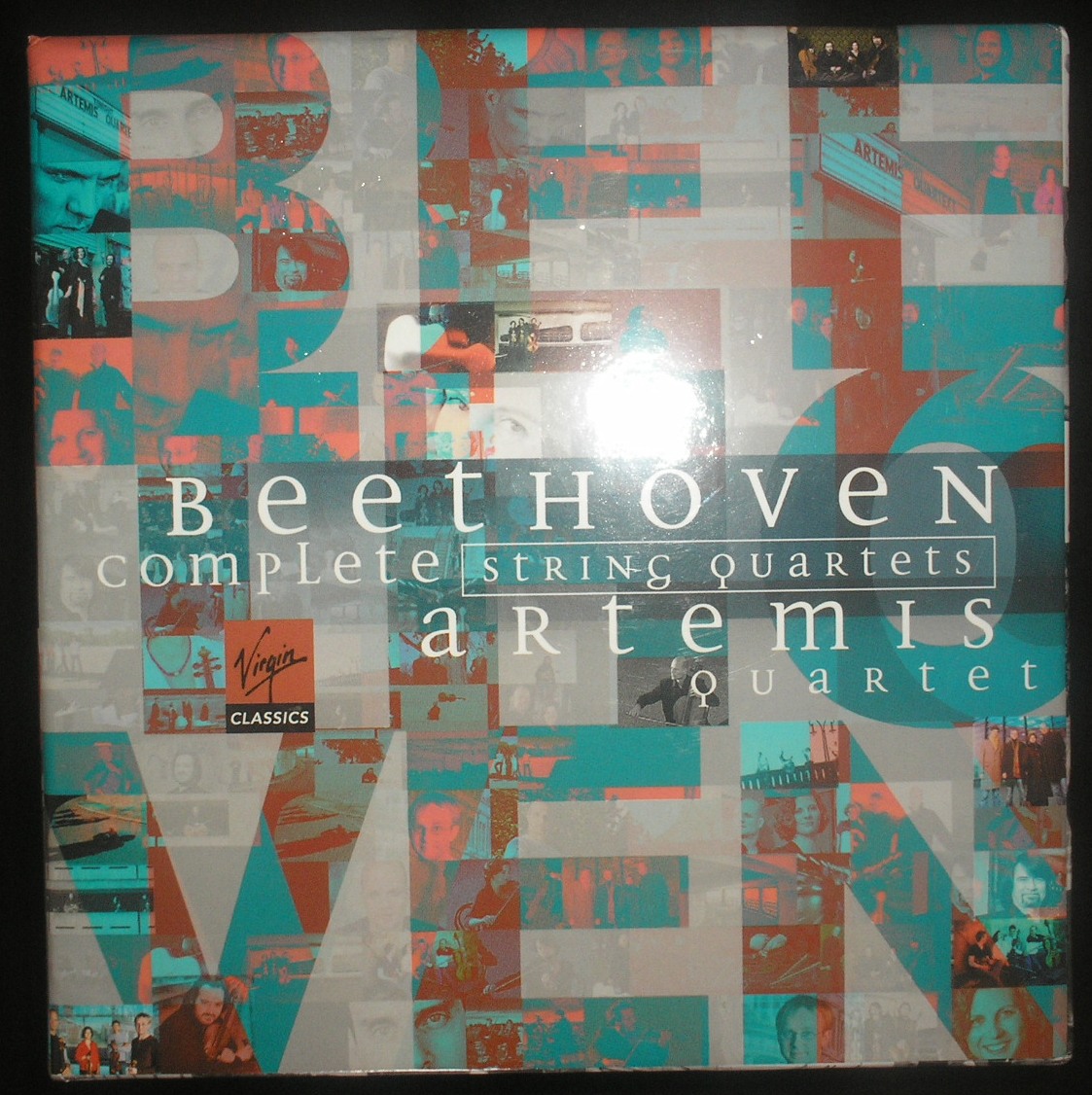
Artemis Quartet
Beethoven - Complete String Quartets


By Tom Pitsis
THE Beethoven Quartets for the next 100 years!
What an incredible, astounding achievement from The Artemis Quartet!
These virtuoso musicians (in technique AND feeling) have managed to make the whole bunch of these miraculous works by Beethoven sound like they were written today! From the earliest Opus 18 works to the final utterance - this set is in its entirety not only faultless, but revelatory to the highest degree. Beethoven has never sounded so witty, so soulful and so intelligent.
I don't know much about these musicians but I'm willing to bet there must be a leader who lays down the law when making performance decisions - I could very well be wrong, but a consensus or committee seldom come up with such consistently brilliant results.
Perfectly recorded - perfectly executed! The wit, drama, spirituality and passion all perfectly voiced.
The part-writing is also crystal clear - The playing of these great musicians has helped me discover inner voices in these great works that I've never noticed before - and I own and regularly listen to many complete sets of these works! The fast finales are as thrilling as roller-coaster rides - yet nothing is blurred - every note can be heard.
Beethoven's not even my favorite composer - Haydn, Bach and Mozart outrank him to my ears - but The Artemis Quartet have reminded me how great 4th place can be and make a strong case for Beethoven's promotion.
My highest recommendation and my heartfelt thanks to these great artists for all the work they must have put in - and for all the sensitivity, experience and wisdom they obviously possess and for their empathy in channeling Beethoven's soul! To have recorded such a stupendous cycle of these works at a time when the classical music recording industry is in dire straits is a tribute not only to the musicians themselves, but to Beethoven, Art, their teachers, the sound-engineers, *Virgin, and even us, the humble listeners. THANK YOU! THANK YOU! THANK YOU ARTEMIS and BUY! BUY! BUY! Classical Music Lovers!

By EMI Classics
This box set from the Artemis Quartet marks Virgin Classics’ first complete cycle of Beethoven String Quartets. Over the past two seasons, the Berlin-based Artemis Quartet has been performing Beethoven around the world, prompting reactions such as this one, from Die Zeit: “The members of the Artemis come as people who live life, and life is what they seek in Beethoven too.”
The first of the Artemis Quartet’s Virgin Classics CDs of Beethoven Quartets was released in Autumn 2005. Now, nearly six years later, the complete Beethoven cycle becomes available in a box of 7 CDs (TBC) which includes two previously unreleased items: the quartet No 10, op 74, known as the ‘Harp’, and a transcription for string quartet, proudly made by Beethoven himself, of the Piano Sonata No 9, op 14.
The 2010-11 season has seen the Artemis Quartet continuing with its two-year focus on live performances of Beethoven. By the end of the season, the ensemble will have recently performed Beethoven quartets in, among other cities, Berlin, Cologne, Frankfurt, Munich, Vienna, London, Paris, Brussels, Rome, Milan, Florence, New York, Philadelphia, Boston, Houston and Los Angeles, and at the Schubertiade festival in Schwarzenberg (Austria).
Eckart Runge, cellist of the Artemis Quartet, expresses the players’ views on the composer’s quartets: “His music speaks to every era – it is a perfect dialogue between tradition and modernity, and between intellectual refinement and raw emotion … In relation to the time in which he lived, Beethoven is the most modern, provocative, experimental and boldest composer of all. Many have used the string quartet to experiment, to trial and develop their mode of composition … but none of them was more extreme than Beethoven. Even today, the Grosse Fuge remains one of the most incredible and most modern pieces of music ever written … No matter how complicated the form, one can always find essential human emotion in Beethoven, whether it is hopeful longing, apprehension, exuberant joy or shy affection.”
Beethoven’s extraordinary musical evolution is traced in the cycle, which remains the touchstone of the quartet repertoire. Die Zeit observed that the Artemis Quartet is: “An ensemble that, when compared to groups on a similar level of perfection, seems to approach the repertoire from another horizon. Many quartets convey an air in their playing of rarefied workmanship and detached refinement from the world. They explore the music within the notes. The members of the Artemis come as people who live life, and life is what they seek in Beethoven too.”
The Artemis’s debut release on Virgin Classics in 2005 comprised Beethoven’s op 59/1 and op 95, while the second release brought together op 59/2, the ‘Razumovsky’ Quartet, and the Quartet op 18/4. In France, the release was named CHOC of the Year by Le Monde de la Musique and was also awarded a Diapason d’Or; in Germany it became Chamber Music Recording of the Year in the ECHO Klassik awards of the Deutsche Phono-Akademie. In the UK, the Sunday Times praised the “fresh, positive responses” of the Artemis Quartet, saying: “ … their colours are vivid and they are alert to the music’s intent to push all sorts of boundaries to breaking point,” while BBC Radio 3’s CD Review suggested that the recording should go to the top of any list of recommendations

Track listing: 
Disc 1:
1 String Quartet No.1 in F major Op.18 No.1: I. Allegro con brio 9:05
2 String Quartet No.1 in F major Op.18 No.1: II. Adagio affettuoso ed appassionato 8:50
3 String Quartet No.1 in F major Op.18 No.1: III. Scherzo (Allegro molto) & Trio 4:00
4 String Quartet No.1 in F major Op.18 No.1: IV. Allegro 6:31
5 String Quartet Op.18 No.4 in C minor: I Allegro ma non tanto 8:22
6 String Quartet Op.18 No.4 in C minor: II Andante scherzo quasi allegretto 7:05
7 String Quartet Op.18 No.4 in C minor: III Minuetto (allegretto) 3:50
8 String Quartet Op.18 No.4 in C minor: IV Allegro 4:15
9 String Quartet Op.18 No.6 in B flat major: I. Allegro con brio 8:37
10 String Quartet Op.18 No.6 in B flat major: II. Adagio ma non troppo 7:43
11 String Quartet Op.18 No.6 in B flat major: III. Scherzo. Allegro - Trio 4:00
12 String Quartet Op.18 No.6 in B flat major: IV. La Malinconia. Adagio - attacca 3:21
13 String Quartet Op.18 No.6 in B flat major: V. Allegretto quasi allegro 4:23
Disc 2:
1 String Quartet No. 2 in G major Op. 18 No. 2: I. Allegro 7:41
2 String Quartet No. 2 in G major Op. 18 No. 2: II. Adagio cantabile 6:25
3 String Quartet No. 2 in G major Op. 18 No. 2: III. Scherzo (Allegro) & Trio 5:09
4 String Quartet No. 2 in G major Op. 18 No. 2: IV. Allegro molto, quasi presto 5:07
5 String Quartet No.3 in D Major Op.18 No.3: I. Allegro 7:22
6 String Quartet No.3 in D Major Op.18 No.3: II. Andante con moto 7:48
7 String Quartet No.3 in D Major Op.18 No.3: III. Allegro 2:47
8 String Quartet No.3 in D Major Op.18 No.3: IV. Presto 6:03
9 String Quartet No.5 in A Major Op.18 No.5: I. Allegro 10:23
10 String Quartet No.5 in A Major Op.18 No.5: II. Menuetto & Trio 4:47
11 String Quartet No.5 in A Major Op.18 No.5: III. Andante cantabile 9:36
12 String Quartet No.5 in A Major Op.18 No.5: IV. Allegro 6:11
Disc 3:
1 String Quartet No. 7 in F 'Razumovsky' Op. 59 No. 1: I. Allegro 9:52
2 String Quartet No. 7 in F 'Razumovsky' Op. 59 No. 1: II. Allegretto vivace e sempre scherzando 8:44
3 String Quartet No. 7 in F 'Razumovsky' Op. 59 No. 1: III. Adagio molto e mesto 12:09
4 String Quartet No. 7 in F 'Razumovsky' Op. 59 No. 1: IV. Allegro (Thème russe) 7:28
5 String Quartet No. 8 in E minor 'Razumovsky' Op. 59 No. 2: I. Allegro 12:42
6 String Quartet No. 8 in E minor 'Razumovsky' Op. 59 No. 2: II. Molto adagio 11:58
7 String Quartet No. 8 in E minor 'Razumovsky' Op. 59 No. 2: III. Allegretto 6:08
8 String Quartet No. 8 in E minor 'Razumovsky' Op. 59 No. 2: IV. Finale (Presto) 5:04
Disc 4:
1 String Quartet No. 9 in C 'Razumovsky' Op. 59 No. 3: I. Introduzione (Andante con moto) - Allegro vivace 10:44
2 String Quartet No. 9 in C 'Razumovsky' Op. 59 No. 3: II. Andante con moto quasi allegretto 9:05
3 String Quartet No. 9 in C 'Razumovsky' Op. 59 No. 3: III. Menuetto (Grazioso) & Trio 5:28
4 String Quartet No. 9 in C 'Razumovsky' Op. 59 No. 3: IV. Allegro molto 5:56
5 String Quartet Op.74: I. Poco adagio - Allegro 9:31
6 String Quartet Op.74: II Adagio ma non troppo 8:34
7 String Quartet Op.74: III. Presto 4:46
8 String Quartet Op.74: IV. Allegretto con variazioni 6:35
9 String Quartet No. 11 in F minor Op.95: I. Allegro con brio 4:02
10 String Quartet No. 11 in F minor Op.95: II. Allegretto ma non troppo 6:34
11 String Quartet No. 11 in F minor Op.95: III. Allegro assai vivace, ma serioso 4:08
12 String Quartet No. 11 in F minor Op.95: IV. Larghetto espressivo - Allegretto agitato - Allegro 4:21
Disc 5:
1 String Quartet No.12 in E flat major Op.127: I. Maestoso - Allegro 6:42
2 String Quartet No.12 in E flat major Op.127: II. Adagio ma non troppo, molto cantabile 14:50
3 String Quartet No.12 in E flat major Op.127: III. Scherzando vivace 8:07
4 String Quartet No.12 in E flat major Op.127: IV. Finale 6:32
5 String Quartet No. 14 in C sharp minor Op. 131: I. Adagio ma non troppo e molto espressivo 7:42
6 String Quartet No. 14 in C sharp minor Op. 131: II. Allegro molto vivace 2:48
7 String Quartet No. 14 in C sharp minor Op. 131: III. Andante moderato 0:47
8 String Quartet No. 14 in C sharp minor Op. 131: IV. Andante ma non troppo e molto cantabile 12:50
9 String Quartet No. 14 in C sharp minor Op. 131: V. Presto 5:08
10 String Quartet No. 14 in C sharp minor Op. 131: VI. Adagio quasi un poco andante 1:54
11 String Quartet No. 14 in C sharp minor Op. 131: VII. Allegro 6:54
Disc 6:
1 String Quartet Op.130 in B flat major: I. Adagio ma non troppo - Allegro 13:08
2 String Quartet Op.130 in B flat major: II. Presto 1:52
3 String Quartet Op.130 in B flat major: III. Poco scherzoso. Andante con moto ma non troppo 6:48
4 String Quartet Op.130 in B flat major: IV. Alla Danza tedesca. Allegro assai 3:03
5 String Quartet Op.130 in B flat major: V. Cavatina. Adagio molto espressivo 6:15
6 String Quartet Op.130 in B flat major: VI. Grosse Fuge Op.133. Ouverture. Allegro - Meno mosso e moderato - Allegro 15:00
7 String Quartet Op.14: I. Allegro moderato 6:56
8 String Quartet Op.14: II. Allegretto 3:37
9 String Quartet Op.14: III. Allegro 3:37
Disc 7:
1 String Quartet No. 15 in A minor Op. 132: I. Assai sostenuto - Allegro 9:32
2 String Quartet No. 15 in A minor Op. 132: II. Allegro ma non tanto 9:13
3 String Quartet No. 15 in A minor Op. 132: III. Molto adagio 16:27
4 String Quartet No. 15 in A minor Op. 132: IV. Alla marcia, assai vivace 2:02
5 String Quartet No. 15 in A minor Op. 132: V. Allegro appasionato 6:39
6 String Quartet No.16 in F major 'Muss es sein? es muss sein!' Op.135: I. Allegretto 6:25
7 String Quartet No.16 in F major 'Muss es sein? es muss sein!' Op.135: II. Vivace 3:20
8 String Quartet No.16 in F major 'Muss es sein? es muss sein!' Op.135: III. Lento assai e cantante tranquillo 6:29
9 String Quartet No.16 in F major 'Muss es sein? es muss sein!' Op.135: IV. Grave ma non troppo tratto - Allegro 7:06


Emerson String Quartet
Mendelssohn - The Complete String Quartets


By D. A Wend
Mendelssohn's string quartets are very appealing, tuneful works that engage the listener completely. Chamber music was an important part of Mendelssohn's output and one does not gain a full picture of his growth as a composer by only being familiar with his orchestral works. This 4-CD set by the Emerson String Quartet brilliantly explores not only the six numbered quartets but includes the shorter Op. 81 works (published after Mendelssohn's death), the student quartet (written when the composer was 14) and the stunning Octet for strings.
Naturally, the early quartets (written in 1827 and 1829 but published in reverse order in 1830) reflect the influence of other composers, most notably Beethoven. The movements of these quartets were linked by thematic ideas. The quartet in A minor uses Mendelssohn's song Frage (Question) as the musical link. The quartet in E-Flat (Op. 12) was composed during Mendelssohn's trip to the British Isles, which also inspired his Scottish Symphony and Hebrides Overture.
When Mendelssohn next turned to the form he was the director of the Gewandhaus and a famous composer. The composition of the three quartets Op. 44 (number 3, 4 and 5) occurred after his marriage to Cecile Jeanrenaud in 1837 and were composed during his two month long honeymoon. These quartets reflect the composer's maturity and accessible style. The sixth quartet was published after Mendelssohn's death and was written following the sudden death of his sister Fanny in May 1847. It follows that the quartet is darker than the others and is agitated and dissonant in tone; the first movement begins with dark tones from the cello then proceeds with a beautiful melody punctuated with tremolos. The scherzo is characterized by an unusual tempo that has a frantic quality to it. The Adagio allows Mendelssohn to fully express his grief and the Finale has the syncopated rhythm of the scherzo.
The five pieces collected as Op. 81 contain what probably are two movements for an unfinished quartet - a Theme and Variations in E major and Scherzo in A minor. It was reported by the composer Ignaz Moschelles that Mendelssohn was at work on a new string quartet before his death and of these two pieces the Theme and Variations is closest to the description of the work. The earliest of Mendelssohn's quartets appears last on the CDs and is a pleasant work written under the influence of Mozart and Haydn.
The Octet receives a marvelous performance with the Emerson playing all of the parts with each member playing different instruments and seated in different positions during the recording sessions.
The performances are impeccable with beautiful and clear sound. I purchased the set anticipating a performance of three of the quartets by the Emerson. As I have listened to the set the warmth and sensitivity of the playing makes this the Mendelssohn quartets to own. I have only become interested in chamber music in recent years and Mendelssohn was a natural choice for me because of his gift of melody. I think this music would appeal to someone getting to know chamber music.

By Deutsche Grammophon
2004 has been a great year for the Emerson Quartet. Sold-out concerts, rave reviews and excellent CD sales apart, they were recipients of the prestigious Avery Fisher Prize in April (bestowed by New York's Lincoln Center), the first ensemble, as opposed to solo artists, to be given this great honour.
Today the Emerson Quartet's exclusive recording catalogue on DG covers music from Bach to Edgar Meyer, and they have won numerous prestigious awards, including six Grammys and two Gramophone Record of the Year awards.
Now they return with a big 4-CD set, this time the complete Mendelssohn quartets. Like their Beethoven and Shostakovich complete cycles of 1997 and 2000 respectively, here is a set of recordings that will set new standards.
The Mendelssohn quartets - seven in all, plus individual movements - form an immensely engaging and exhilarating body of work. They range from the passionate utterances of the young composer (opp. 12 & 13) to the anguished outburst of a man devastated by the death of his beloved sister (F minor, op. 80). In between there are the chamber-music equivalents of works like the famous Italian Symphony (the D major op. 44 no. 1).
On the special bonus CD that comes in the package there's an absolute treat: the Emerson's recording of Mendelssohn's delightful Octet, a work brimming with energy and lyricism. How do four players play eight parts? Find out on the CD-R track, "Recording the Octet", a witty and enlightening eleven-minute documentary of eight Emersons in action - also included on the bonus CD.

Track List:
CD 1:
String Quartet No.2 in A minor, Op.13

1 1. Adagio; Allegro vivace [7:40]
2 2. Adagio non lento [7:53]
3 3. Intermezzo; Allegretto con moto [4:44] 
4 4. Presto [8:59]
Four Pieces for String Quartet, Op.81
5 4. Fuga [4:58] 
String Quartet No.1 in E flat, Op.12
6 1. Adagio non troppo; Allegro non tardante [7:54] 
7 2. Canzonetta: Allegretto [3:55]
8 3. Andante espressivo [3:57] 
9 4. Molto allegro e vivace [7:52]

CD 2:
String Quartet in E minor, Op.44, No.2

1 1. Allegro assai appassionato [10:34]
2 2. Scherzo. Allegro di molto [4:06]
3 3. Andante [6:05]
4 4. Presto agitato [6:20] 
String Quartet in E flat, Op.44, No.3
5 1. Allegro vivace [12:35]
6 2. Scherzo: Assai leggiero vivace [4:05]
7 3. Adagio non troppo [8:12]
8 4. Molto allegro con fuoco [8:23]

CD 3:
String Quartet in D, Op.44, No.1

1 1. Molto allegro vivace [12:55] 2
2. Menuetto. Un poco allegro [5:33]
3 3. Andante espressivo ma con moto [5:25]
4 4. Presto con brio [6:58]
Four Pieces for String Quartet, Op.81
5 3. Capriccio [5:52] 
String Quartet No.6 in F minor, Op.80
6 1. Allegro vivace assai [7:25] 
7 2. Allegro assai [4:24] 
8 3. Adagio [6:43]
9 4. Finale: Allegro molto [5:23]
Four Pieces for String Quartet, Op.81
10 1. Tema con Variazione [5:45]
11 2. Scherzo [3:26]

CD 4:
Octet in E flat, Op.20

1 1. Allegro moderato, ma con fuoco [13:43]
2 2. Andante [6:47]
3 3. Scherzo (Allegro leggierissimo) [4:14]
4 4. Presto [5:39] 
String Quartet in E flat major o. op.
5 1. Allegro moderato [8:49]
6 2. Adagio non troppo [5:15]
7 3. Minuetto - Trio - Minuetto [5:51]
8 4. Fuga [4:02]
9 Video Documentary: "Recording the Octet" [13:00]

Sunday, August 26, 2012

2 Sem 2012 - Part One

Maria João Pires
The Piano Sonatas - Wolfgang Amadeus Mozart (1756 - 1791)


By Orpheus "a wayfarer" (on the road)
I agree completely with the above reviewer. Maria Joao Pires is one the world's most influential and admired Pianists, her interpretations of Mozart, Chopin, Schumann and Beethoven have been lauded and her concerts are sold out within days. Throughout her career though, she returns again and again to the music of Wolfgang Amadeus Mozart.
Mozart Sonatas lack the pathos and gravity of Beethoven's, but reveal a beauty more etheric and elusive. It is not for nothing that most pianists do not dare to touch them, as they represent a world that seems simple and one-dimensional, but is in fact the complete opposite. Mozart' inclination to simplicity reveals, when played by someone with a kindred soul, his Incomparable Genius. Maria Joao Pires does just that.
Her tone is a delicate and lyrical one: warm, soulful, clear and adept to Mozart's subtle and intricate compositions. What I most like about her is her sense of timing and flowing momentum that expresses the essence of a Mozartean Sonata.
You could say this is the most rounded and soulful collection of Mozart's sonatas . But that would not give enough credit to Maria Joao Pires Artistry. Each and every piece is played with an almost unassuming elegance and clarity; no manierisms, ideosyncracies, just a springing forth of the Music.
She creates an atmosphere of delicate intimacy and tranclucent beauty, I have never heared before. She expresses it all: the elegance and lyricism of Mozart love for Opera, his ability to summon a sense of heartbreaking joy and splendour, longing and humour, deep agony and elusive freedom...the whole gamut of the highest of human sentiments and capabilities.
Of course there are other great boxes such as Brendel, Uchida, De La Rocha, Gould. But Pires' unique empathic sensitivity capture something which surpasses just a great performance but touches the heart of Mozart's music.

Track List:
CD 1:
Piano Sonata No.1 in C, K.279
1.1. Allegro 6:59
2.2. Andante 8:58
3.3. Allegro 5:28
Piano Sonata No.2 in F, K.280
4.1. Allegro assai 6:33
5.2. Adagio 8:48
6.3. Presto 4:36
Piano Sonata No.3 in B flat, K.281
7.1. Allegro 6:48
8.2. Andante amoroso 8:16
9.3. Rondeau (Allegro) 5:06

CD 2:
Piano Sonata No.4 in E flat, K.282
1.1. Adagio 7:16
2.2. Menuetto I-II 4:02
3.3. Allegro 3:23
Piano Sonata No.5 in G, K.283
4.1. Allegro 5:31
5.2. Andante 6:31
6.3. Presto 6:13
Piano Sonata No.6 in D, K.284 "Dürnitz"
7.1. Allegro 7:37
8.2. Rondeau en Polonaise (Andante) 5:31
9.3. Tema con variazione 17:04

CD 3: 
Piano Sonata No.7 in C, K.309
1.1. Allegro con spirito 8:49
2.2. Andante, un poco adagio 6:37
3.3. Rondeau (Allegretto grazioso) 7:07
Piano Sonata No.9 in D, K.311
4.1. Allegro con spirito 6:58
5.2. Andantino con espressione 5:56
6.3. Rondeau (Allegro)6:53
Piano Sonata No.8 in A minor, K.310
7.1. Allegro maestoso 8:01
8.2. Andante cantabile con espressione 9:11
9.3. Presto 2:49

CD 4:
Piano Sonata No.10 in C major, K.330
1.1. Allegro moderato 9:08
2.2. Andante cantabile 6:54
3.3. Allegretto 7:48
Piano Sonata No.11 in A, K.331 -"Alla Turca"
4.1. Tema (Andante grazioso) con variazioni 14:12
5.2. Menuetto 5:42
6.3. Alla Turca (Allegretto) 3:42
Piano Sonata No.12 in F, K.332
7.1. Allegro 9:17
8.2. Adagio 4:44
9.3. Allegro assai 9:58

CD 5:
Piano Sonata No.13 in B flat, K.333
1.1. Allegro 9:58
2.2. Andante cantabile 12:16
3.3. Allegretto grazioso 6:35
4.Fantasia in C minor, K.475 11:59
Piano Sonata No.14 in C minor, K.457
5.1. Molto allegro 8:14
6.2. Adagio 7:28
7.3. Allegro assai 4:37

CD 6: 
Piano Sonata "No.18" in F, K.533/K.494
1.1. Allegro, K.533 10:02
2.2. Andante, K.533 10:12
3.3. Rondo (Allegretto), K.494 6:42
Piano Sonata No.15 in C, K.545 "Facile"
4.1. Allegro 4:15
5.2. Andante 6:04
6.3. Rondo (Allegretto) 1:38
Piano Sonata No.16 in B flat, K.570
7.1. Allegro 8:38
8.2. Adagio 8:42
9.3. Allegretto 3:43
Piano Sonata No.17 in D, K.576
10.1. Allegro 5:02
11.2. Adagio 6:17
12.3. Allegretto 4:48

Sunday, March 18, 2012

1 Sem 2012 - Part One

Sergio Monteiro
Heitor Villa-Lobos - A Prole do Bebê I e II


By SMonteiro
"This is the first time that the two "Proles do Bebê"(Baby's Family) are recorded in the same CD by a Brazilian pianist. According to the distinguished Brazilian composer Almeida Prado, the Baby's Family n. 1, from 1918, "has the French influence of Debussy and Ravel associated with a very ingenious use of Brazilian rhythms." Three years later, in 1921, V. Lobos wrote the second cycle of "Prole do Bebê". "This time", says the critic, "the change in style is astonishing. A very different pianism, agressive- sometimes even brutal- is combined with a highly sophisticated harmony (bitonal, atonal), and new rhythms coming from the Sacre du Printemps are enriched by the originality of V. Lobos.":

PROLE DO BEBÊ Nº 1
01 Branquinha2m40s
02 Moreninha 1m38s
03 Caboclinha 2m57s
04 Mulatinha 1m21s
05 Negrinha 1m17s
06 Pobrezinha2m07s
07 Polichinelo 1m28s
08 A Bruxa 2m08s

PROLE DO BEBÊ Nº 2
09 A Baratinha de Papel 2m45s
10 A Gatinha de Papelão 2m45s
11 O Camundongo de Massa 2m55s
12 O Cachorrinho de Borracha2m35s
13 O Cavalinho de Pau 2m13s
14 O Boizinho de Chumbo 4m44s
15 O Passarinho de Pano 3m19s
16 O Ursinho de Algodão 2m23s
17 O Lobozinho de Vidro 4m41s


Dan Tepfer
Bach/Tepfer - Goldberg Variations/ Variations


By Robert Carraher "The Dirty Lowdown"
Dan Tepfer is one of the most formidable jazz pianists on the international stage and hailed as such by press on every continent you can keep a piano in tune (Antarctica does not qualify). He has owned the spotlight the world over, from his solo work to full orchestra performances, and his improve skills are awe inspiring. His style is more melodic, he's not one to display his technical prowess through big blasts of dissonance and drama. This comes to the listeners ear as playful, fun, sexy and just beautiful. There is such a rainbow of musical colors that it takes you away before you even knew you were packed.
He has chronicled his talents on the solo disc Twelve Free Improvisations in Twelve Keys (2009) as well as the trio sessions Before the Storm (2005), Oxygen (2007) and Five Pedals Deep . Here, he brings that melodic lyricism to JS Bach's Goldberg Variations. To tackle the masters iconic work is a pretty ambitious ideal, but Tepfer is more than equal to the task. This is no popular music take on Bach, so don't expect A 5th Of Beethoven or Hooked On Bach. This is a masterful pianist, a classically trained pianist and a young man who has been praised wherever he has graced the ears of jazz and classical fans giving us a respectful and affectionate interpretation of the complete "Goldbergs" and interspersed are his improv variations on Bach's Variations...did that make sense?
For Tepfer, this was no "romp" through the play ground, no playful process for showing off. He disappears into the music and I am told that he even engineered this disk himself to further immerse himself in the pieces and the project. In between Bach's own variations are Tepfer's improvisation and though true to the original you can feel the kiss of jazz. Wonderful stuff. My advice to you. Grab a good book, and put this album on and get lost in a marvelous disk.


Jacques Loussier Trio
Schumann/ Kinderszenen - Scenes From Childhood


by Alex Henderson
Over the years, third stream music has been criticized in both the jazz and Euro-classical worlds. Jazz snobs have argued that if a jazz musician is playing something by Beethoven or Chopin, he/she can't possibly maintain an improviser's mentality; classical snobs will argue that great classical works need to be played exactly as they were written, and that jazz artists can't possibly do the compositions of Schubert, or Debussy justice if they improvise. But thankfully, Jacques Loussier hasn't paid attention to the naysayers in either the jazz or classical worlds, and after all these years, the French pianist (who turned 76 in 2010) is still taking chances. This 2011 release finds Loussier putting his spin on "Kinderszenen (Scenes from Childhood)," which German romanticist Robert Schumann (b. 1810, d. 1856) composed in 1838. Schumann turned 28 that year, and he wrote that nostalgic, 13-song work in memory of his childhood. Loussier (who forms an acoustic piano trio with bassist Benoit Dunoyer de Segonzac and drummer André Arpino) performs "Kinderszenen (Scenes from Childhood)" in its entirety, and he approaches it not as European classical music, but as acoustic post-bop jazz. Thankfully, "Kinderszenen (Scenes from Childhood)" is appropriate for Loussier, who maintains the 13 songs' nostalgic outlook but does so in a consistently jazz-oriented fashion. Loussier sounds like he is fondly remembering his own childhood, which came about long after Schumann's. Indeed, Loussier was born in 1934, which was 96 years after "Kinderszenen (Scenes from Childhood)" was composed and 78 years after Schumann's death; Loussier grew up surrounded by a lot of music and technology that didn't exist when Schumann was a kid. But the more things change, the more they stay the same and nostalgia continues to inspire musicians today just as it did in Schumann's pre-jazz, pre-electricity, pre-records time. This 49-minute CD is among Loussier's creative successes; his experimentation hasn't always worked, but it works impressively well for him on this imaginative interpretation of "Kinderszenen (Scenes from Childhood)."


Evgeny Kissin
Mussorgsky: Pictures At An Exhibition


By Stephen Wigler
Any recording of Busoni's transcription of Bach's mighty organ Toccata, Adagio and Fugue in C will inevitably be compared with the Vladimir Horowitz performance that opened his "comeback" recital in 1965and the 78-rpm-era version of Arthur Rubinstein (resurrected on Volume 8 in BMG's Rubinstein Collection). Kissin gives us Horowitz's brilliance, without the nervous affectations and missed notes, and Rubinstein's healthy athleticism and grandeur, without the occasional inattention to detail. In a performance such as this, Kissin convinces us that he is at once the Horowitz and the Rubinstein of our era--and perhaps superior to either. In Mussorgsky's Pictures at an Exhibition, Kissin almost never falters in evoking the inherently Russian quality of the tableaux: the heartbreak of unrequited passion in the "Old Castle"; the lurching to and fro of "Bydlo"; the mimicry of "Tuileries"; the helter-skelter bargain-seeking of "Limoges"; and the spooky depths of "Catacombs" and "Con mortuis in lingua mortua." Perhaps "The "Hut on Fowl's Legs" and "The Great Gate of Kiev" have only been surpassed in live recitals by Kissin himself and, of course, by Sviatoslav Richter--the best of whose live performances, recorded at a 1958 recital in Sofia, is still available on a Philips disc. Kissin's encore, Balakirev's transcription of Glinka's "The Lark," demonstrates that, when it comes to creating a singing line, with sensitive phrasing and exquisite textures, he has no equal among pianists alive today.

By Vidar Palsson
I have spent the latest week listening to Kissin's newest CD. And here are my thoughts:
- Bach/Busoni:
Kissin's clear tone suits the work perfectly. His tone is sharp and the pedalling is held to moderation. The toccata is virtuosic at times and Kissin rses to sound as a whole organ. The adagio is slow and beautifuly colored by Kissin. Each phrase has weight and you sink in your chair listening to it. But the best is yet to come, the fugue. I wish Kissin would play more poliphonic music like fugues because he is a master at dragging forward inner voices. His fingers seem to have individual life and the lines eash gain their own existance. Listen to the beginning of the fugue, such clarity, focus and calm. The breath of tone in this work displayed by Kissin shows clearly his capability to make the piano sound like any other instrument he likes, organ, orchestra or what ever.
- Glinka/Balakirev:
Small work I haven't heard elsewhere. Melancolic, slow and beautiful. An ok break between the two major works on the disc.
- Mussorgsky:
Listening to Kissin led me into yet one Pictures-mania. So, there has been a lot of comparisons this week. I must say it straight out: genius! This is what I call a high class performance. In his last CD (Chopin: 2nd sonata, preludes) his tone got a bit to hard at times, and I was curious is he would try the power-path of Horowitz or the poeticism of Richter. I am glad he choose the latter, although I love Horowitz's version(s). Take for exaple the Bydlo. Yes, Horowitz is funny and exiting when he unleashes a thunderous left in the high climax. But such a force makes the bydlo more of a crasy bull than a slow, fat and lumpish ox, making heavy steps. Kissin hold back the banging and portraies the bydlo as slow but powerful force. The fast sections, like the market or the ballet of the chickens, sparkle with life. The grand gate of Kiev is magnificent, truly grand and noble.
Conclusion: A CD to treasure as it contains a stunnig Bach/Busoni and one of the very best pictures ever, arguably the best pictures for a long long time. Kissin is the successor to Richter and Horowitz in Mussorgsky, no doubt in my mind.